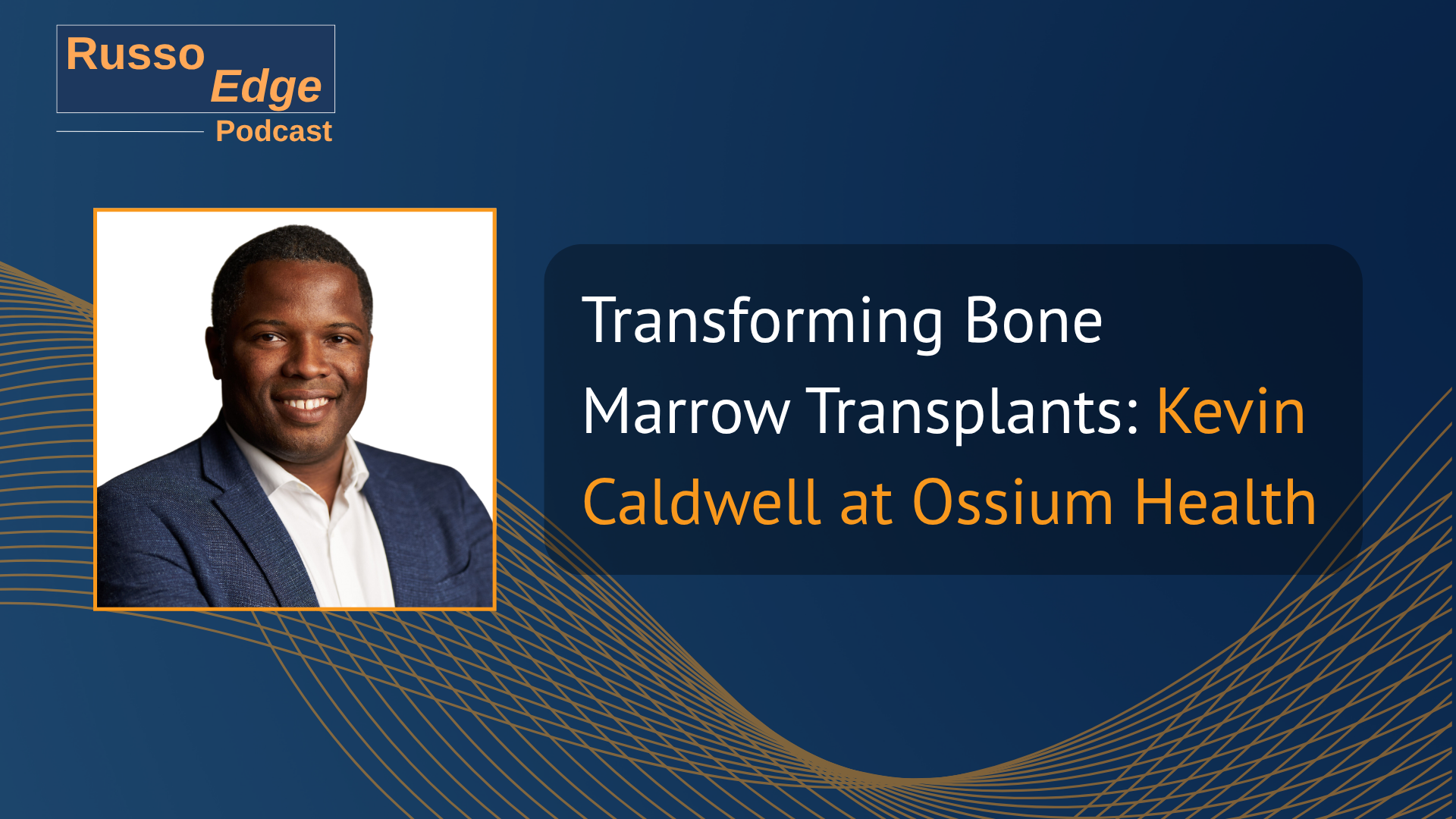
Kevin Caldwell, CEO and co-founder of Ossium Health, joined the Russo Edge Podcast to share the groundbreaking work his company is doing to revolutionize bone marrow transplants.
Learn how Ossium Health is leveraging innovation to store life-saving bone marrow from deceased organ donors and improve outcomes for patients with serious blood cancers. With host Solomon Wilcots, this episode covers the challenges of scaling biotech solutions and the transformative potential of modern medicine.
Solomon Wilcots: Our guest on the Russo Edge Podcast has a hot idea to help patients with serious blood cancers, and you’ll find it in the deep freeze. Welcome, everyone, to the Russo Edge Podcast. Today’s conversation is with Kevin Caldwell, the CEO, co-founder, and president of Ossium Health in San Francisco.
At Ossium, Kevin has created the world’s first bank of lifesaving, on-demand bone marrow stem cells for transplant. That bone marrow is kept safely in the deep freeze until it’s needed by patients who are waiting for a donor. Prior to that, Kevin spent years in technology and investments. He grew up on a small farm in Tennessee, where he cared for his grandparents and that’s where he first saw the flaws in the healthcare system.
Kevin, welcome to the program. How are you doing today?
Kevin Caldwell: I’m doing well, Solomon. Thank you for having me.
Seeing Systemic Flaws Through a Child’s Eyes
Solomon Wilcots: Well, obviously it’s great to have you. Let’s go ahead and get started. Let’s talk about some of your younger days when you were growing up in Tennessee and what you witnessed with your grandparents. It was what you saw there that set you on a path to make changes in the healthcare system. How did that happen?
Kevin Caldwell: Yeah, so I grew up in Middle Tennessee. My parents are both from Nashville, and that’s where I lived during the school year and spent much of my time. During the summers, every long weekend, on the holidays, my parents would take me out to my grandparents’ farm in West Tennessee, about ninety minutes outside of the city. I learned everything I could about living and working on the farm from my grandparents. One of the consequences of spending so much time with my grandparents as a kid was that, by the time I was in high school, they were getting up in age and they spent more and more time in the healthcare system.
What I noticed first is that I would see them getting sick at home. Then we would take them to a doctor, where they would get retroactively diagnosed and given an intervention. It usually reduced their suffering but didn’t necessarily improve their health.
I would ask, why can’t we anticipate what’s going to make them sick ahead of time? And why don’t we have more interventions that actually restore their health rather than just treating their symptoms? The answer I got was, “That’s just not how healthcare works.” I never really accepted that. Ultimately, the motivation to change that is part of what led to Ossium.
Translating Strategy and Due Diligence Into Entrepreneurship
Solomon Wilcots: That’s a very powerful story. Let’s fast forward to the work you’ve done in investments and consulting with McKinsey. How did that set the groundwork for the work you’re currently doing at Ossium?
Kevin Caldwell: I joined McKinsey’s healthcare team out here in San Francisco in 2014. Most of our clients I worked with were global healthcare and biopharma companies.
Much of the IP (intellectual property) and many of the new assets that global pharma companies get comes from buying biotech startups. Typically, the pharma company would have a startup already identified that they were interested in potentially acquiring. They’d essentially hire us to evaluate the company and make a recommendation on whether to buy it or not.
We’d only have a few weeks to do this because the pharma company would have about a month to make a final decision. We would come in cold, study a business, go through its data, its clinical data and its preclinical data, talk to investigators on its clinical trials, the management team, value the business, and then make a recommendation to do it or not within about three weeks. We typically would do seven days a week, sixteen hours a day during that period. I’d take a couple of days to sleep and go do it again. I saw a lot of biotech companies go through that.
Banking Bone Marrow From Organ Donors
Solomon Wilcots: A really great learning experience for you, as well. You’ve got some great work done. I now understand you’ve hit some tremendous milestones. The first patient has had a successful bone marrow transplant using your platform at Ossium. It must be really a proud moment for you, your company, your employees, the patients, physicians, and the entire organ donor community. What more can you tell us about it?
Kevin Caldwell: At Ossium, we’ve built a platform for banking transplantable bone marrow from organ donor vertebral bodies. The same organ donors that provide hearts, kidneys, livers, and lungs—who have been relied upon for solid organ transplant ecosystem for more than sixty years throughout the world. What we’ve developed is a process for getting some lifesaving bone marrow stem cells from those very same donors.
There’s an enormous ecosystem involved in this. We work closely with organ procurement organizations that consent to donations from families and perform the recoveries. We’ve built our own facility in Indianapolis to process the bone marrow. Much of the underlying science and intellectual property behind this novel process was developed by my co-founder, Erik Woods. It’s something the entire team is enormously proud of. We’ve spent eight years developing the product, building out the platform, and doing animal studies to prove that viable, functional cells could be retrieved from organ donors.
This year, we’ve treated our first three patients already and have seen tremendous outcomes in those patients. Our very first patient was a sixty-eight-year-old woman in Michigan. She had no donors available, she was diagnosed with acute myeloid leukemia, and her medical team was running out of options. We connected with then and we identified a matching donor in our bank for her and provided her with a bone marrow transplant. She’s had a tremendously successful outcome—full engraftment—and has returned to normal life.
Scaling Access to Bone Marrow Transplants Through Education
Solomon Wilcots: Wow, Kevin, that’s very exciting and phenomenal news. What’s next for you and Ossium?
Kevin Caldwell: The current bone marrow transplant ecosystem has about twenty thousand patients every year—mostly those diagnosed with blood cancers—who are looking for a bone marrow donor. Just over half of them—just over ten thousand— receive a bone marrow transplant. The other half of those patients often become so weak while looking for a donor, that they are no longer eligible for the transplant. There are also patients who could potentially benefit from a transplant with non-malignant disorders who don’t even go looking for one because the process takes time.
Our goal over the next couple of years is to dramatically increase the availability of bone marrow transplants and the outcomes that these patients can receive so that the vast majority of patients who need a transplant can receive one.
It’s worth noting how powerful bone marrow transplants are. We already think about stem cells therapies as 21st century medicine, and for the most part that’s true, but a bone marrow transplant is a type of stem cell therapy that has 70 years of medical history behind it. When we do these transplants, we permanently replace the blood and immune system of the recipient with that of the donor. For the rest of the recipient’s life, they will produce blood and immune cells with the genetics of another human being. In principle, you can treat many diseases of the blood and immune system with this procedure. It’s incredibly powerful. At Ossium, our goal is to make this vastly more accessible to more people.
Solomon Wilcots: I think that’s phenomenal, obviously, the ability to share that and democratize it. As you look forward to the future, how important is it to clearly communicate with everyone who is working within the ecosystem—from investors to doctors, patients, and the organ donor community, and even biotech CEOs?
Kevin Caldwell: As we treat more patients and generate more and more promising data from these successful outcomes, the major task that we have transitions from just making the product and treating patients to communicating about it. Around the world, thousands of patients every year don’t know that the opportunity to get a bone marrow transplant from a source like Ossium exists and they may have given up hope without knowing about these innovations that we’ve made. One of our core goals over the years to come is the broad education about the quality of the results we’ve generated and about the hope it creates for patients worldwide.
Building Ecosystems, Not Just Products
Solomon Wilcots: What other words of wisdom can you share with other biotech CEOs when it comes to the importance of communication—internally, externally, with other companies and even within your own ecosystem?
Kevin Caldwell: I would say just a few things. One is that there’s a wealth of innovations that are published in the medical literature each year that is never reviewed by entrepreneurs who could potentially take those ideas and use them to build businesses that really have a dramatic impact on patients.
If we look at the work that Ossium has done, there were bone marrow cell recoveries from deceased donors before Ossium existed. There was bone marrow transplants many decades before we existed. But no one had ever built the ecosystem at scale necessarily to be able to do these transplants, not just for one or two patients in a proof-of-concept study, but for many thousands of patients every year.
Going through and systematically asking yourself how you can take the science and bring it to the world at scale, I think is the fundamental challenge and opportunity of the entrepreneur. I think many of the barriers that people think are impossible, a lot of the obstacles that people initially said couldn’t be overcome, like accessing organ donors around the United States, building a large and diverse bank, building a facility that could process and hold it all, all of these things can be done with grit and with time. It’s been eight plus years, almost nine building Ossium to date, and the fortitude of sticking with it is incredibly important.
Solomon Wilcots: Well, we want to say thank you to our guest and to our friend Kevin Caldwell, CEO Co-founder and president of Ossium Health for joining us on the Russo Edge Podcast today. Thank you for tuning in everyone
The Russo Edge Podcast is hosted by Solomon Wilcots and features candid conversations at the intersection of biotech, healthcare, and innovation, spotlighting leaders, scientists, and investors moving medicine forward. The following transcript has been edited for clarity.