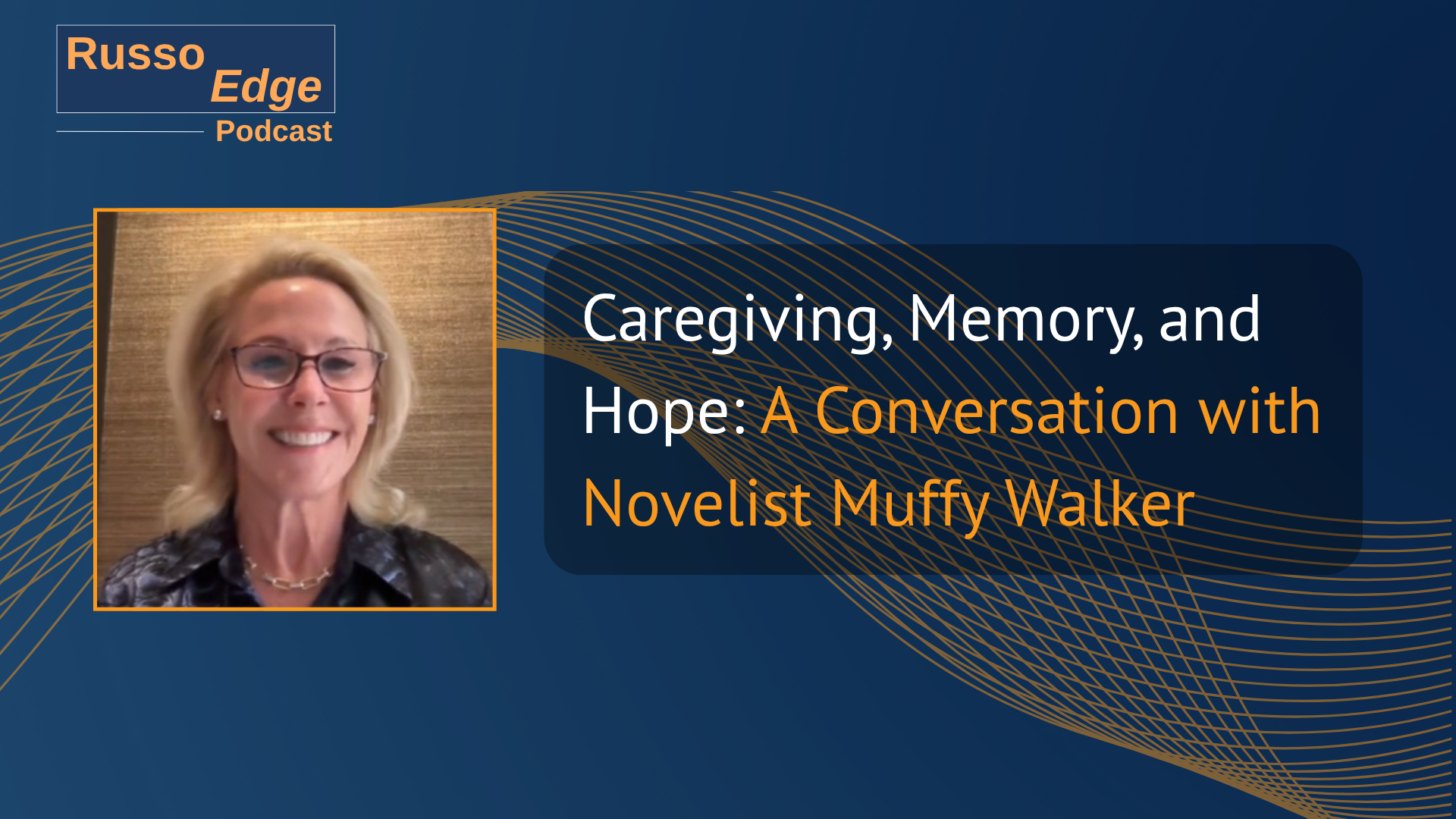
When memory fades and caregiving becomes a daily reality, how do we hold onto hope? In this episode of the Russo Edge Podcast, novelist and mental health advocate Muffy Walker shares how her experiences helped inspire her debut work of fiction, Memory Weavers.
Set in the late 1990s and early 2000s, the novel follows two women navigating friendship, trauma, and early-onset memory loss. Drawing from her background as a psychiatric nurse and advocate, Muffy talks about why she chose fiction to explore these emotional realities, how stigma impacts families, and why telling these stories matters. This heartfelt conversation offers resilience, compassion, and inspiration for anyone touched by memory loss, trauma, or mental health struggles.
Why Mental Health Became a Lifelong Mission
Solomon Wilcots: Welcome to the Russo Edge podcast. Today we’re speaking with Muffy Walker, a mental health advocate and psychiatric nurse and founder of the International Bipolar Foundation. She brings that same compassionate insight to her debut novel, Memory Weavers, a story that is already being praised by leaders in neuroscience and psychiatry for its emotional resonance and scientific authenticity. Muffy, welcome to the Russo Edge podcast. How are you doing today?
Muffy Walker: I’m good Solomon. How are you?
Solomon Wilcots: Look, we’re doing great. It’s always great to have you on with us. Today we’re gonna have an interesting conversation. Let’s get started by asking, what led you into psychiatric nursing and eventually into the mental health advocacy?
Muffy Walker: Thank you. I think I’ve always been a caregiver at heart. Even as a young child, I tried to take care of my parents and my older siblings. I was a candy striper. I worked in an ambulance corps and then I went to nursing school. During nursing school, I was most excited by doing the psych rotation. Most of the girls in my rotation were petrified to go on to the locked unit in the psychiatric hospital. I was actually really excited about it. It just innated me, I believe.
When Family Experience Turned Into Global Advocacy
Solomon Wilcots: See, I think speaks to just the soul and the heart that you have to help others and I think it also speaks to your courage. Now, I know you founded the International Bipolar Foundation. When was the moment that told you that you were ready for something like this? When was that moment? When did it all crystallize for you?
Muffy Walker: I have a family member who was diagnosed with early onset bipolar disorder at a very, very young age. At the time, this is probably 23, 24 years ago, there were very few resources available. So, I started as a psychiatric nurse running support groups out of my home for other caregivers with loved ones with bipolar disorder. I didn’t run it as a psych nurse. I ran it as a mom. Through those support groups, I found so many highly educated people who were grappling and trying to figure out how to navigate the system. Myself and three other moms decided that we needed to start this foundation to help people. the foundation is almost 18 years old, and we know we’re reaching people in over 180 countries. It’s a great organization.
Turning Caregiving Experience Into Fiction
Solomon Wilcots: It is a great organization. You continue to do great work in that space. So what inspired you to write Memory Weavers and how much of your own experiences informed the characters and the themes within this book?
Muffy Walker: My mother was diagnosed with Alzheimer’s disease about 23 years ago, and one day sitting in my living room, she said she wanted to trade brains with someone who had a lesser evil disease. I thought, that’s a book idea. 13 years ago, I started writing this book. It’s obviously has changed course many, many times over the years of writing. I would say about 90% of the memory lapse scenarios in the book are directly from my personal playbook of taking care of my mother. My mother-in-law also now has Alzheimer’s disease, and I was a caregiver to her for quite some time. The caregiver in me as a daughter, a nurse, and an advocate really comes through in the books.
Understanding Stigma Through Story and Character
Solomon Wilcots: Now, the story in the book follows two women, Hadley and Rachel, their friends, navigating memory loss and trauma. So what do you want readers to know and maybe walk away with after reading the book?
Muffy Walker: That’s a great question, Solomon. I really want the readers to come away with the skills and the resources that the book offers. I’m giving people resources at the back of the book. I’m talking about stigma associated with these two disorders. Rachel has PTSD, Hadley has early onset Alzheimer’s. I want people to know what the life of the caregiver is and the family members. I really want people to go away with some resources.
Solomon Wilcots: Those resources can help a lot of people. In particular, maybe even more specifically, if the readers say they’re patients or maybe even caregivers, right, or professionals, what do you want them to take away? Some of the resources, are there experiences within the book that you think they can learn from maybe before they’ve encountered some of these things themselves?
Muffy Walker: Yes, as you mentioned at the beginning, the book has been endorsed that it is scientifically and neurologically correct. So, I’m not leading people astray. These are true examples and resources that are mentioned throughout the book. The one thing that I do want readers to know though, is that my book takes place in the late 90s, early 2000s, before a lot of this transformational research and treatments had been discovered. I do want people to know that 23 years later, 25 years later from when this book is placed, there is much more hope now. And we are very, very close to finding a cure for Alzheimer’s.
Channeling Passion Into the Next Chapter
Solomon Wilcots: Well, between your nonprofit work, your writing, and your advocacy, how do you stay motivated to keep going? Where do you find the energy to really just keep moving forward the way you have?
Muffy Walker: I think it’s just part of who I am. I’m already thinking of the next book. I think about the book for a long, long time. Then all of a sudden, I just start writing. So, I’m already thinking about the next book and how I can reach more people. I’m probably going to write a book with a character with bipolar disorder. So again, really wanting to reach and educate more people
Solomon Wilcots: Yeah, really smart, great, wonderful way to look at it. Finally, I got to ask you, where can people find the book Memory Weavers and where can they follow a lot of the work that you do?
Muffy Walker: Memory Weavers is available on over 30,000 book sites. I think you can visit your local bookstore. I don’t know if they have it in stock, but of course, always on Amazon. You can follow on Muffy Walkerwalker.com. I have my events, my endorsements, the various books that I’ve written. That’s the best place to find me.
Solomon Wilcots: Well, you do so much and just a phenomenal and tremendous advocate. We wish you all the best in your future work. We want to also give you a heartfelt thank you to Muffy Walker for joining us today. Of course, from her work and as an advocate to her debut novel that she has written, she really has shown that she is a front runner when it comes to advocating for mental health and really wonderful storytelling. She does a wonderful job of connecting with people. We think that many of the themes that you write about, it overlaps with a lot of the things that people need and the necessities for life. We appreciate all the great work. I’m Solomon Wilcots everyone. Thank you for joining us right here on the Russo Edge Podcast. Thank you for listening.
The Russo Edge Podcast is hosted by Solomon Wilcots and features candid conversations at the intersection of biotech, healthcare, and innovation, spotlighting leaders, scientists, and investors moving medicine forward. The following transcript has been edited for clarity.