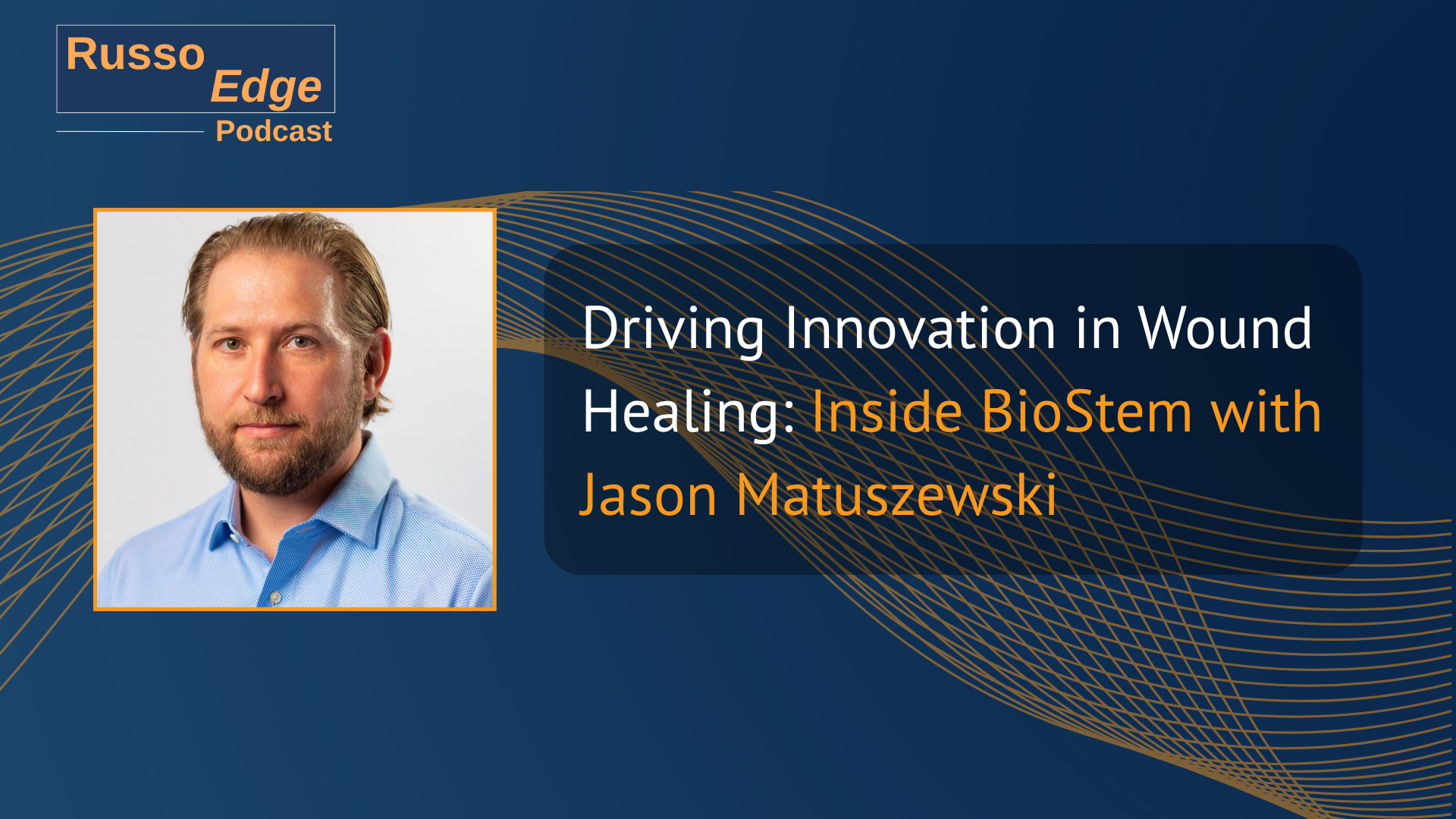
What happens when an engineer from professional motorsports applies that same precision and drive to regenerative medicine? On this episode of the Russo Edge Podcast, Jason Matuszewski, CEO and Co-founder of BioStem Technologies, a company providing placental tissue products to heal chronic wounds that often defy standard treatment.
Jason shares how BioStem’s proprietary BioRetain® technology is helping patients avoid amputations and get back to living. With a scalable manufacturing operation and a mission rooted in compassion and science, BioStem is tackling one of healthcare’s most persistent challenges. If you’re interested in innovation, entrepreneurship, or the future of wound care, this conversation is not to be missed.
Solomon Wilcots: Welcome to the Russo Edge podcast, everyone. I’m your host, Solomon Wilcots. Today’s, we’re speaking with Jason Matyszewski, CEO and co-founder of BioStem Technologies. Jason’s path from the racetrack to regenerative medicine is nothing short of remarkable. He began his career as an engineer in professional auto racing, building safer, faster racing cars. Now he leads BioStem Technologies. To bring that same high-octane mindset to healthcare.
BioStem is now a public regenerative medicine company turning placenta tissue, yes, the afterbirth into advanced wound care products that gives hope to patients with hard to heal wounds. Under Jason’s leadership, the company has built a state-of-the-art manufacturing facility and brought multiple regenerative products to market, helping heal wounds where other treatments have failed. Jason, welcome to the show. How are you doing today, my friend?
Jason Matuszewski: Good, thanks, Solomon. Thanks for having me on the show today.
From Racetrack Engineering to Regenerative Medicine Leadership
Solomon Wilcots: Great to have you. Let’s get started with your racing days. We have to go back and talk about that. I think it’s rather interesting. An unconventional beginning for a Med Tech leader. How did you end up as a CEO of a biotech firm?
Jason Matuszewski: It’s actually an interesting story. My co-founding partner’s father and I met actually at the racetrack and that’s the genesis of this organization. I started racing when I was five years old and go-kart racing here in the United States and all over world. I had an opportunity to kind of parlay that into driver coaching at one point. Then hanging up the suit after a ripe old age of 19 years old, and had the opportunity to work with drivers, specifically in Mazda Motorsports’ division, working with guys like Patrick Dempsey, who enjoys sports car racing, which is a really cool experience, as well as my co-founding partner’s father.
After a few years of knowing him, he was diagnosed with a rare brain tumor and went to the Karolinska Institute in Stockholm, Sweden, received a gray matter radiation treatment and was left with stroke-like symptoms on half of his body and then sought, how do I heal these symptoms to get back to normal cognitive function. We always made a joke. It was like Windows 95; he would fall apart after about two o’clock in the afternoon. He went and received a regenerative medicine treatment.
That’s where the genesis of this company started as he received a therapy from the company. The original owner of this company said, “Would you guys be interested in investing?” He looked to me as well as my family collectively and we put the capital together to actually buy the entity and then the rest is history, I guess you would say.
Transforming Placenta Tissue Into Life-Saving Therapies
Solomon Wilcots: It’s a rather rich history and one that turned out to be very rewarding. For those who are unfamiliar, help us understand. What is BioStem’s core mission?
Jason Matuszewski: Our core mission currently is to manufacture products that change lives. That’s utilizing the placental based tissue products and working with the gracious donors with a gift donation to service patients that typically are Medicare beneficiaries 65 and up fighting to save their limbs and lives. Saving lives is at our core as well. It’s a complete honor to be able to work with gracious donors that give the exciting elements of a new baby, a new birth, and taking that tissue and utilizing it for patients that are sadly struggling on the other side of the spectrum.
Solomon Wilcots: BioStem has developed this proprietary technology called BioRetain for processing placenta tissue. Why was it important to create your technology for this purpose?
Jason Matuszewski: The core of developing this is really looking at the competitive landscape. We looked at other manufacturers of placental-based tissue products and said, hey, is there a better way to do this? Is there a more efficient way? Is there better way to retain, hence the name BioRetain, more of the natural properties of the tissue? Those are kind of the two geneses of developing the BioRetain technology platform. Today we have 55 patents currently issued. We have about 52 patents in provisional status. Continuing to build an IP portfolio around that and working on now clinical trials to demonstrate that the attributes of BioRetain and retaining all those natural properties in the placental tissue.
Expanding Impact While Respecting the Donation Process
Solomon Wilcots: What has been the biggest challenges in scaling your operation and bringing these really unique products and this tissue product more specifically to help patients?
Jason Matuszewski: Of course, forward education, right? Getting prospective mothers at maybe their second term of their pregnancy to understand why to donate tissue. Sadly, a lot of this material ends up getting thrown away as medical waste. It’s a gracious honor to be able to work with this donated tissue because it really goes into a significant amount of medical history about the donor, meaning the mother. Their personal history, by going through that and getting into their medical and social history past, that’s a challenge, right? Allowing somebody to know some of the things about you and then ultimately allowing you to actually donate this tissue and really what is the underlying cause as to why you’re doing that, right? What’s the mission? And the mission obviously is to be able to offer these products and make these products for patients that are in need and hopefully saving their limbs and saving their life.
Solomon Wilcots: Jason, let’s switch gears a little bit and talk a little more about the market. Chronic wounds, as you well know, are wounds that are resistant to healing, and they really are a silent epidemic, and it costs the healthcare system tens of billions of dollars each year. Can you elaborate a little a bit more on the market and what excites you the most about working in this space?
Jason Matuszewski: The market is pretty massive. There are over 7 million chronic wounds in the U.S. Alone. We have 50 million Medicare beneficiaries today, growing to 80 million Medicare beneficiaries by 2030. Sadly, about 15 to 20% of those folks end up with a chronic wound. So that hockey stick is going up. We can only do so much work on the GLP-1 front to mitigate diabetes, but vascular issues and other things, diet and whatnot, ultimately, we have a situation whereas you age, your skin, your tissue breaks down, and we end up with these types of chronic wounds. This issue isn’t going away and being able to offer and develop a product like ours to support folks with chronic wounds is great and an amazing opportunity.
Scaling Manufacturing Through Team, Discipline, and Execution
Solomon Wilcots: Amazing opportunity. It’s great when that hockey stick points up, right? You really have scaled up MetTech from a small startup to a publicly traded company. That’s no easy feat, right. So BioStem now has over 6,000 square feet of manufacturing space in your facility. How did you manage to pull that off?
Jason Matuszewski: A team is everything, right? As you know, probably from your professional sports experience, having a great team is all about being able to scale and being able to deliver great products. My co-founding partner who is the chief operating officer, Andrew Van Vers, has a military background, Marine. Operationally, he is the man in charge and really been able to command and be able to get us to manufacture these products and get them out the door and really grow the manufacturing operation from a quality and execution perspective.
Solomon Wilcots: Well, as a CEO, you’re also wearing many hats. You wear the hat also of the chief communicator. That’s why we wanted to have you here to talk with us and educate us today. You’ve got to keep investors, right? You got to have healthcare providers on board and even patients in the loop as you continue to have more progress. What is your approach to pulling everyone together, whether it’s providers, investors, or patients as well?
Jason Matuszewski: It’s obviously the core mission, right, is to manufacture products that change lives and save limbs. Pulling everybody together, telling them the story, what is our true initiative? I think what’s really impactful is when you see a patient thrive. A great example, we had a story where a gentleman who wanted to do the first dance with his daughter at her wedding, but he had a really chronic wound on the bottom of his foot, and we had an opportunity to treat that chronic wound and give him the opportunity to have that first dance with his daughter.
Powerful scenarios and stories about how big of an impact these products have on patients’ lives really communicate the story for yourself. They always say the proof is in the pudding, right? Talking about some of those experiences with patients and delivering their patient experiences with the products has helped us communicate our story and our journey.
The Next Frontier for Regenerative Tissue Products
Solomon Wilcots: Help us understand maybe what’s next for BioStem. There are new applications. I’m sure there’s endless possibilities as you sit with your team and start to imagine what you can do with placenta tissue technology. There’s got to be some other new products on the horizon. What’s in the pipeline? What can you tell us at this point?
Jason Matuszewski: Being a public company, it’s hard to tell you forward things in depth. But we’re really focused right now on the mobile wound care space. Our goal is to really start looking at the hospital space and being able to deliver our products into the surgery suite. That could be utilization in sports medicine that could be utilization in urology, all sorts of areas. Plastic surgery use cases, hernia, abdominal recon, things of that nature. There’s a lot of great use cases for these types of tissue. Reducing inflammation in areas. Maybe you have an ACL tear, right? Being able to have that surgically repaired but then utilize this tissue to reduce the scar tissue, reduce inflammation in that area. I think there’s a lotta opportunity on the horizon. You know, other areas like working with the DOD and the Veterans Administration, being able to service those sites of service as well as kind of on the horizon initiatives for us.
Solomon Wilcots: So Jason, do you have any words of wisdom for other biopharma entrepreneurs and leaders who are out there? Kind of what advice would you give someone who has a big vision in biotech when it comes to overcoming hurdles or just staying on track and moving even closer to achieving their goal?
Jason Matuszewski: Team is everything, right? Being able to have a great team, trusting your leaders within their verticals, having a lot of good clear communication, direct communication with everybody, makes sure everyone’s moving the rowboat in the right direction, right? It also takes a lot of courage at times, and sometimes it’s a humbling process. You take two steps forward, and then all of a sudden three steps backwards, and lessons are learned there. Trying to dive in and dig into what were the lessons learned? How do we not make those mistakes again? And drive forward, with intent going forward.
Solomon Wilcots: Well, Jason, it’s great having you on the show. Phenomenal information, you’re a wonderful CEO and co-founder of BioStem Technologies. We want to thank you for joining us on the Russo Edge podcast. From the fast-paced world of auto racing to the forefront of regenerative medicine, Jason’s journey exemplifies innovation, adaptability, and purpose-driven leadership. I’m Solomon Wilcots everyone. Thank you for joining us on the Russo Edge podcast. Thank you for tuning in, we’ll see you next time.
The Russo Edge Podcast is hosted by Solomon Wilcots and features candid conversations at the intersection of biotech, healthcare, and innovation, spotlighting leaders, scientists, and investors moving medicine forward. The following transcript has been edited for clarity.