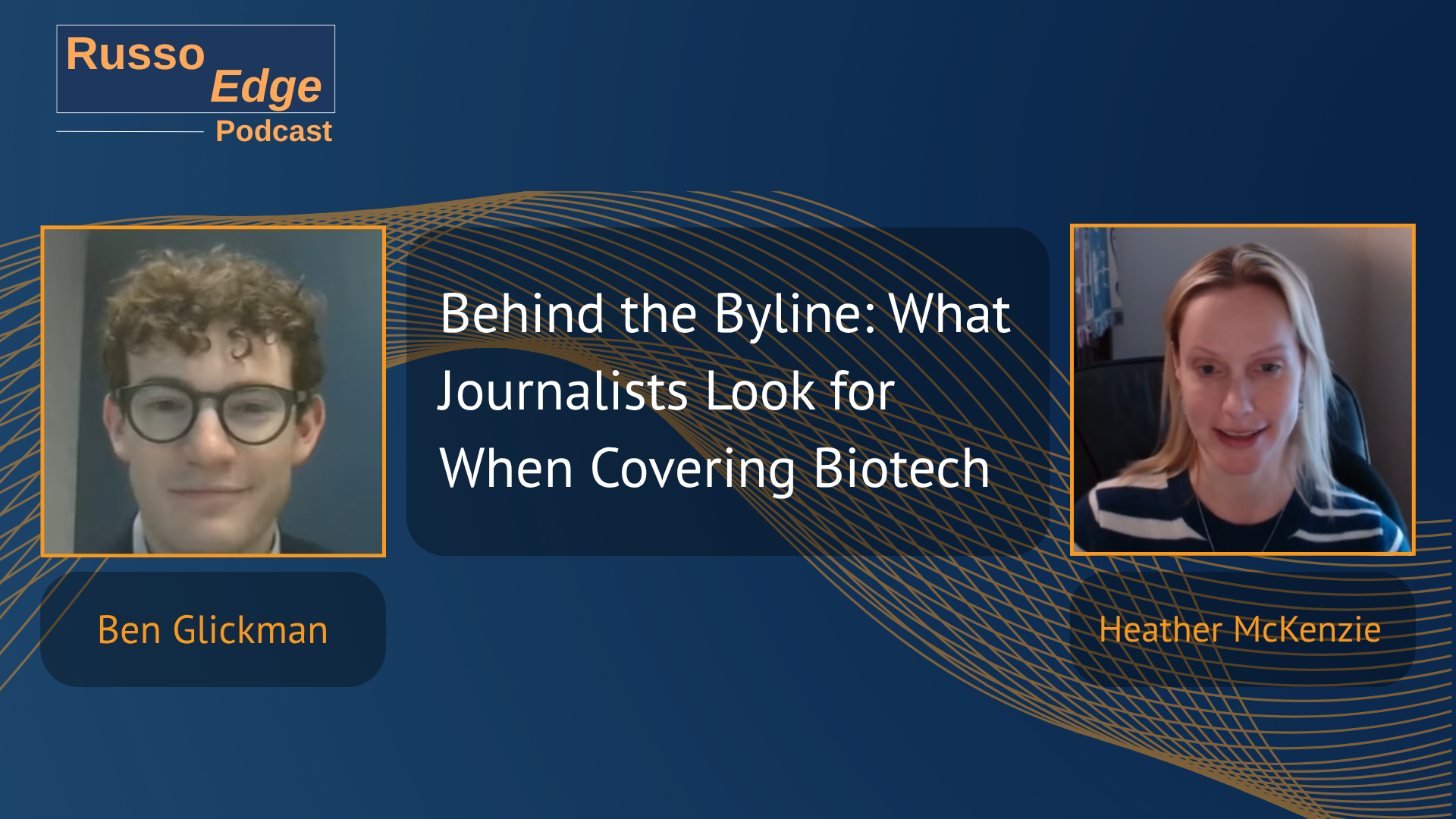
In this episode of The Russo Edge, two leading journalists pull back the curtain on how science becomes a headline. Heather McKenzie, Senior Editor at BioSpace, and Ben Glickman, Reporter at The Wall Street Journal, join host Solomon Wilcots to share what earns their attention, what builds trust, and what turns them off before a single question is asked.
Together, they break down how biotech companies can communicate complex data with clarity, why timing is everything when engaging in the press, and how credibility can be strengthened long before a major announcement. From background conversations to clear trial summaries and investor context, this conversation offers practical, real-world advice for biotech leaders.
How Two Newsrooms Define Relevance in Biotech Coverage
Solomon Wilcots: Welcome to the Russo Edge. I’m your host, Solomon Wilcots. Today, we’re pulling back the curtain on how biotech stories become headlines and how your team can work smarter with the press. Joining me today are two pros who live where science meets the front page. Heather McKenzie is a senior editor at BioSpace. She’s evidenced first, known for her clear-eyed coverage across neuroscience, rare disease, and for tying data to real patient impact. Also joining us is Ben Glickman. He’s a reporter with the Wall Street Journal, covering M&A, shareholder activism and market moving disclosures. Yes, including pharma and biotech. He brings a capital market perspective on valuation and governance. Ben, Heather, you guys doing well today. Thanks for joining us.
Heather McKenzie: Yeah, thanks for inviting me.
Ben Glickman: Happy to be here.
Solomon Wilcots: Well, let’s get started. I have a question. This is for both of you. For listeners who don’t know you very well, give us a quick version of what you cover and how you decide what’s worth your time on a very busy day.
Heather McKenzie: Yeah, I’ll go first. At Biospace, we pretty much cover everything that is important to the biopharma industry. Mid to senior level executives, we cover everything from regulatory to policy. That could be anything from the Inflation Rejection Act to the Most Favored Nation drug pricing. We’ve been doing a lot of that lately. To therapeutic breakthroughs. That’s one of my favorites, I love to get to write about that. To M&A, which Ben would have a lot to do with. Yeah, so I’ll turn that over to Ben.
Ben Glickman: Yeah, I have much less subject area knowledge than Heather, but nonetheless, I cover M&A, mergers and acquisitions, and shareholder activism for the Wall Street Journal. I primarily cover deals on the smaller end. So for us, that’s sort of below five billion, which I know in the general world is still pretty big. But I also just kind of have a general interest in the biopharma space. Obviously, there’s plenty of dealmaking to go around within biopharma, whether its reverse mergers at the end of the life of some biotech or some big multi-billion-dollar deal by AstraZeneca or Pfizer. I’m generally interested in the space, and I tend to cover things across the industry spectrum.
What Builds Credibility Fast With Biotech Journalists
Solomon Wilcots: Well, that’s really good stuff, and it’s certainly a broad spectrum when you think about what you both cover. This is for both of you. What’s the fastest way for someone to earn your trust when first making contact? And what’s the one thing that makes you skeptical right away?
Heather McKenzie: I would say the best way for someone to earn my trust is to answer my questions honestly and without a script. I think it’s pretty obvious when someone is following a script if they don’t answer my questions and instead answer my question with a different answer to some other question. It’s pretty obviously if someone is following a script that their company wants them to. I know that people have to do that to a certain extent, especially in big pharma companies, because there are legal reasons and there are PR reasons.
You’re going to get a much better story out of it if you try to give as much information as you can while walking that line between what’s good for investors and what’s for really getting the information and the data out there.
Solomon Wilcots: Being conversational really does go a long way, doesn’t it?
Heather McKenzie: It does. And it goes a long way for your company’s reputation as well. We wrote a story about this lately that the reputation for biopharma companies, they’re known as the bad guy. That’s not fair because these are companies that are developing life-saving medicines. Lots of cancers have become chronic in the past two decades and that’s largely thanks to pharma. It doesn’t get recognized because of insane drug prices, which I’ll acknowledge are relatively high. I think there’s lots of reasons for companies to be as candid as possible.
Solomon Wilcots: Ben, what about you?
Ben Glickman: I like the political nosedive we just took there into drug pricing. I would say that for me, because I’m not necessarily always covering biopharma, being conversational and talking in a more kind of naturalistic way as if we’re just having a normal conversation over a beer always makes a huge difference in terms of just establishing a connection where the next time you meet that person, you’re going to be excited to be talking with them.
Then for me personally, I write a fair amount about biotechnology companies, but I’m no scientist. I don’t have a PhD. I also don’t spend all of my time reading industry news. People who kind of break down for me what they do in understanding that I am not necessarily the most knowledgeable about biopharma, it’s always much appreciated that people are understanding of where I’m coming from.
How Background Conversations Create Better Stories and Better Context
Solomon Wilcots: That’s a really good point and I guess that leads me to this: when if ever is an advance in conversation helpful to set the ground rules a little bit up front for transparency? And when can background conversations can also be very important to help set up the interview for greater success? That question is for both of you. Heather, how about you take it first?
Heather McKenzie: I think it’s always advantageous to have a background conversation, as many as you can, especially in areas that you follow quite closely. I mean, for me, that would be neuro. I’ve been talking a lot with companies who focus on Huntington’s disease and ALS recently, really for the past few years. Those are two main coverage areas of mine. It often leads to a lot of serendipity because maybe the source is in one area, but they’re looking at something else. Or maybe the company is in one area, but looking at it something else, and then you find out more about their experience and their expertise, and it leads to whole different story. Then you’ve got two stories, or you’ve got a story for your freelancers. I think it’s always advantageous.
I think that also establishes those connections, because the companies are always changing. People at the top are always changing. It’s important for us to establish that company tree with all of the people who are in charge, both PR representatives and the executives. I wish that there were 56 hours in the week so that I could do eight more hours.
Solomon Wilcots: Ben, those conversations could be very informative.
Ben Glickman: I feel like to have a conversation to start out before there’s anything on the record or anything like that is really helpful because I get to walk people through how my job works and how what things we’re going to be covering. I’ll write a story about if this or the other deal happens, but I might not be writing a story about a licensing agreement, for example. Explaining where I fit into this whole ecosystem leads us to address things that are more relevant to exactly what I might be working on, whether that’s a trend story about biopharma deal-making or a specific therapy area that’s been really hot.
I might write a Nash story right now with Akero. Anything where I can kind of set the tone and help people understand how my role might be different from someone like Heather, who is way more in this world and understands it way better than me. That makes the conversation much more productive.
From Readouts to Roadmaps: Information Journalists Actually Need
Solomon Wilcots: So, when you’re on that first call, what do you need for that interview to maybe have in front of them so that they don’t waste the time? Maybe it’s certain data points or certain information. Maybe it’s something from a news release that you need for them to have so that it’s a fruitful conversation when you are on that first call.
Heather McKenzie: Yeah, so I think it depends on what kind of story we’re writing. If it’s a data drop, the more data, the better. I was speaking with one individual today who kind of picked apart the data from a recent big readout and he said that he really wanted more data from the individual patients. He wanted more information on a specific biomarker which the company didn’t provide. He said this was probably because the biomarkers wasn’t positive which would influence the investors, which he understood.
But just as much as you can walk that line between what’s good for the company and what you can actually share. I think it’s important really to get that message out there through the media to the patients who are going to be reading this and to other companies who are developing treatments.
Ben Glickman: Yeah, I would say actually very different from what Heather said. Generally, I’m looking for the broad arc of a company when I meet with someone from that company. The time when I’m going to be like most likely to jump in and be writing about that company is if they’re acquired by a big pharma or if they IPO or other deals kind of related to that. To understand sort of the therapy area that a company is working in, what is the actual mechanism of action? How they think what they’re developing is unique from competitors? Those kinds of broader overarching things tend to be really helpful from my perspective because it helps me kind of place it in whatever kind of image I’m forming in my head of the broader ecosystem, which is just as important as understanding a particular company from my perspective.
Turning a Data Drop Into a Story and Providing Context for Readers.
Solomon Wilcots: Heather, this question is for you. What is maybe the most common clarity gap that you see in trial news when it’s being released? And how do you close that gap? How do you go about fixing it?
Heather McKenzie: Think I’m going to just cannibalize my answer to that question with the last answer. The most significant gap we usually see is outside commentary in press releases. Usually, it’ll be the trial investigator that the company will have comment for the press release. That’s great, but it’s not exactly as outside as our audience wants to see. They’d like to see somebody from a different academic institution who wasn’t involved in the trial comment for a completely unbiased opinion.
The other things are exactly what Ben said in his last answer, what it means for the industry, what it means overall. This would be not so much in the press release, but in a in a post interview or in the pitch when the PR representative is pitching it to us. Early in my career, I had one awesome PR person. She was a former journalist, and she would write these pitches that would write my story for me. She was incredible and she would put in outside commentary; she would fit in the context. It was just incredible; I took all of her pitches and ran with them.
Solomon Wilcots: Really good stuff. Ben, this one’s for you. When you cover biotech, what ties the science to market value and what context do you want upfront for your readers to assess what’s most important to assess that significance?
Ben Glickman: That’s a good question. For me, I think a lot about the commercial potential of the treatment. In the same way that there are specific indications where we all understand that it could make whoever commercializes it a lot of money. That tends to be the thing that interests a lot of investors and that interests me by proxy. So commercial potential and there’s a lot of things that are connected to that. Whether there’s some specific mechanism of action that makes it kind of unique from a manufacturing perspective or anything that speaks to why the market is going to care about that in two years, five years, ten years?
When Politics Hits the Data: Engaging Media With Honest Context
Solomon Wilcots: Heather, you often cover science where the politics gets really loud, right? How do you want companies to engage with you in that environment?
Heather McKenzie: Yeah, that’s been a real factor this year, in 2025 especially. I would say with as much transparency and honesty as you can. When you’re covering a data story it’s not usually a problem. Companies don’t want to get away from the data unless they’re being impacted by the political environment, in which case they still probably won’t say very much, but when they do it is a terrific story because these are issues that are affecting our industry. If they are honest about it, then you really get to dig into an issue that’s having a considerable effect.
We had one story that I wrote earlier this year where a company was affected by FDA leaks to the media and this CEO I spoke with was very candid about it. It led to an excellent story, and I think it was important to put out there. It’s not always a matter of that they should be avoiding politics; it’s a matter of how you go about walking that line in balance.
How Shareholder Campaigns Gain Traction in the Public Markets
Solomon Wilcots: Well, Ben, you cover activism. What early signals do you look at a campaign and see that it’s gaining traction? What responses from board members do you actually think about that you know will land with investors?
Ben Glickman: I think that the thing that tends to show the most is stock price reaction. When you see that this is clearly a stock jumping after some regulatory filing goes out, that lets us know this is clearly something that investors have strong opinions about. From there, we often seek out an array of perspectives from the investor community. Whether that’s sell side analysts who are always happy to talk, hedge funds, or larger money managers where they might have a specific kind of bio fund manager who is likely the person who’s going to have an opinion about it. We try to sort of gage the room, and that’s a big part of it. I don’t know if that answers your question.
Solomon Wilcots: No, I think it does. I think that’s a really good idea. I know that coverage always morphs in certain areas, right? So, I want to get a prediction from both of you and just how much you think biotech coverage is subject to change over the next 12 months. What stories are we going to be talking about maybe six to 12 months from now? Where is all of it going?
Heather McKenzie: Well, I think in a lot of ways, we’re already in it. We’re already in the cycle that we’re going to be in the next six to 12 months: drug pricing. We’ve already had Pfizer and AstraZeneca go ahead and make deals with the White House. I’m sure that J&J has commented that they don’t have a deal yet, but that they have been thinking about it before day one. I think that’s going to be one issue.
Weight loss is not going away. GLP ones are not going to go away anytime soon. Inside the media standpoint, media outlets will have to be very careful that we continue to stick to the facts even more so than usual to ensure accurate coverage in this really hyper partisan environment. We’ll also have to avoid burnout because this is an unrelenting pace of news. It just doesn’t stop. It used to be where in the spring we had a busy conference cycle and then in the fall we had a busy conferences cycle and JPM. But other than that, there were kind of lull times. There are no lull times anymore.
Solomon Wilcots: No time to exhale at all, is there?
Ben Glickman: I agree that I think we’re already in it. The other thing I would highlight that has started to take root is the general sentiment about biotechnology as a sector. There was the first half of the year, it was very downbeat. I was at the bio conference and people were not feeling super joyous. There was a lot of talk about how markets have been hit really hard, how private funding is not as available as a lot of people would like, how generalist investors have flooded out of the sector. Now it appears like XBI has done really well over the last two months. I heard on a street column from this week, that says biotech’s rallying again.
Those kinds of boom-and-bust cycles I think are inevitable, but it does feel like the fortunes are turning to the positive. More funding being available, less regulatory uncertainty, M&A pipelines have been super robust, and I think that will continue for the next year unless there’s some giant wrench that gets thrown in the machine, which there very well could be. But there does seem to be a shift that I’ve noticed in the last month or two that I would expect to continue and things are turning back positive for the industry.
Heather McKenzie: That’s something we’ve noticed, too. Yesterday, there was a company that has a late-stage weight loss therapy, and they got 600 million in a series B. Then today, there is a company focused on preventing or recovering hair loss, and they got 120 million or something like that, which surprised me for a company like that. Is hair loss the new weight loss?
Solomon Wilcots: Well, it’s certainly a robust pipeline for news and information, and I’m sure you guys will be all over it. We want to thank you for the great information. Thank you to Heather McKenzie, Ben Glickman for sharing your knowledge with us. I’m Solomon Wilcots. This is the Russo Edge. Thank you for joining us.
The Russo Edge Podcast is hosted by Solomon Wilcots and features candid conversations at the intersection of biotech, healthcare, and innovation, spotlighting leaders, scientists, and investors moving medicine forward. The following transcript has been edited for clarity.