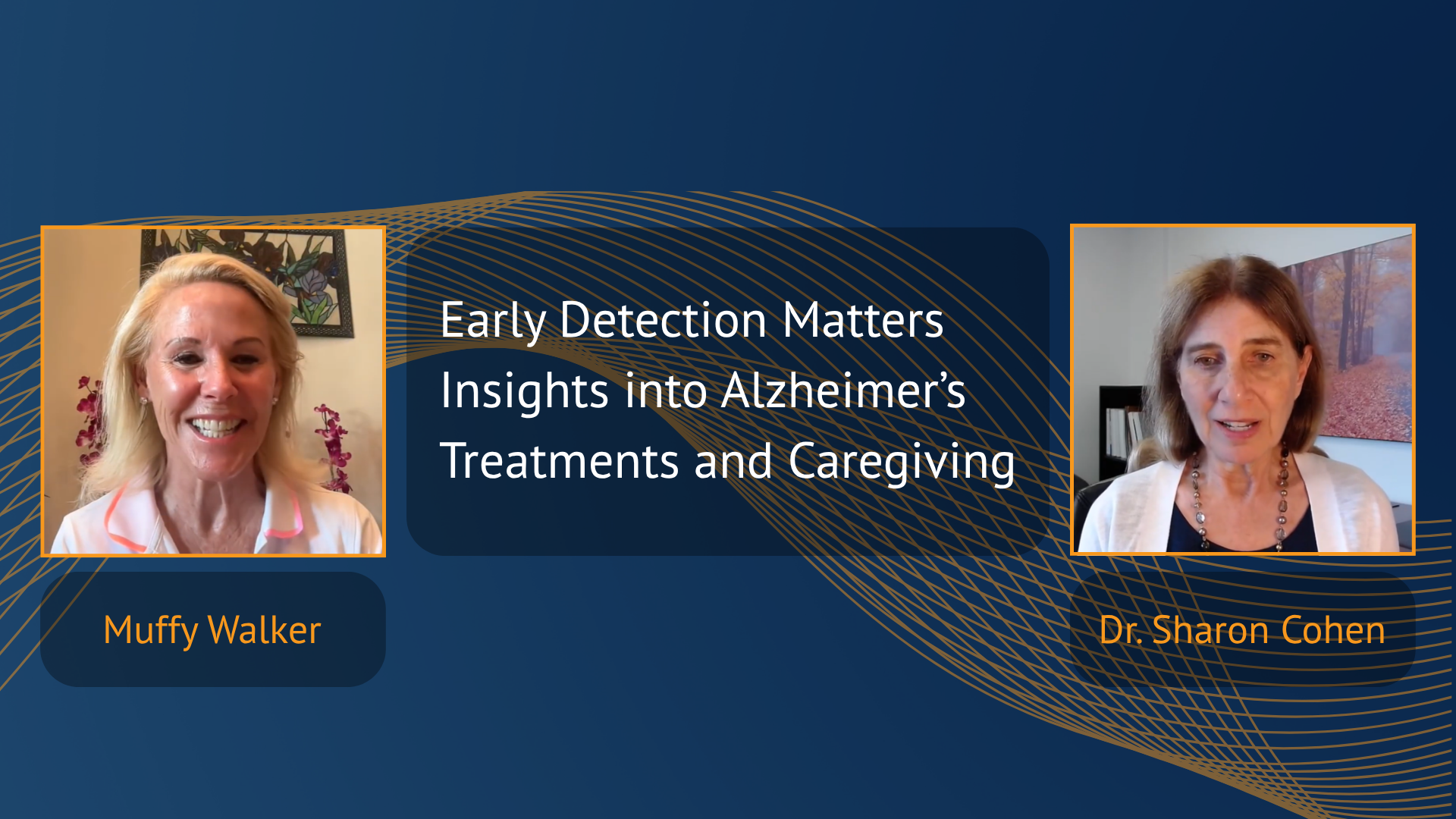
In this episode of Conversations That Matter we’re talking about the latest in Alzheimer’s progress in diagnosis and treatments, support for families and how we tackle stigma head on. We’re joined by two outstanding guests.
Muffy Walker is a psychiatric nurse, longtime mental health advocate, founder of the International Bipolar Foundation and author of Memory Weavers, a caregiving rooted novel that captures the complexity of early onset Alzheimer’s and trauma-related disorders shining a light on the profound impact of friendship and human connection in the face of adversity.
We’re also joined by Dr. Sharon Cohen is a Behavioral Neurologist and the Medical Director of the Toronto Memory Program, a leading memory clinic and research center where she’s helped advance early diagnosis and access to clinical trials.
Personal and Professional Journeys Into Brain Health Advocacy
Solomon Wilcots: I’m Solomon Wilcots, your host for this special program exploring science, caregiving, and human side of Alzheimer’s. Before we dive in deeper, let’s get a quick introduction in your own words. Muffy, can you explain more about your background and what brought you to this work?
Muffy Walker: Yes, I am a psychiatric nurse practitioner. I obtained my graduate degree in nursing at the University of Pennsylvania, and I worked for about 20 years in the platform of survivors of abuse, so a lot of PTSD patients. I also have a family member who was diagnosed with bipolar disorder over 23 years ago. So that was where the founding of International Bipolar came from.
Solomon Wilcots: Sharon, can you give us a brief introduction, your current clinical focus and why you decided to devote your career to Alzheimer’s.
Dr. Sharon Cohen: I think neurology chose me even as a child. I was fascinated by how do we know how to speak? How do we say what we say and think what we think? Those thoughts carried me through all of my childhood and adult life. The brain is mysterious, beautiful, fascinating, but when things go wrong, it is devastating for people. I really believe that Alzheimer’s disease is a treatable and curable disease and I’ve been working for the last 30 years. To get us further in early diagnosis and new treatments. The last few years have been very rewarding. We are having successes.
Alzheimer’s Then and Now: Care, Knowledge, and Progress
Solomon Wilcots: Well, that’s really good news. Muffy, your novel, Memory Weavers, is set in the late 90s, early 2000s. It captures what Alzheimer’s looked like and felt like then. What did you want readers to understand about that specific era?
Muffy Walker: I wrote the book Memory Weavers as you can see here and it is fiction, but it’s based on the playbook basically of my mother who was diagnosed with Alzheimer’s over 24 years ago. My mother-in-law now has Alzheimer’s. So, I’ve been a primary caregiver to two parents with this disease. The point that I want to bring out about my fiction novel is that it is based in the early 2000s, before we had all of this transformational work that is taking place. I’m sure Dr. Cohen will tell us a lot more about that, but I do give a lot of educational pointers in the book that have been endorsed as scientifically and neurologically spot on. I point out once again; this is based in the early 2000s. There is a lot more hope, many, many more options today than there were when my book takes place.
Solomon Wilcots: Sharon, if we were to fast forward to today, what is the biggest shift from that era to now in terms of diagnosing Alzheimer’s?
Dr. Sharon Cohen: Absolutely a huge paradigm shift. I started my training in the 1990s and actually in the 1980s. And in those days, we really didn’t recognize Alzheimer’s for what it was. It was conflated with dementia, meaning you were very impaired later stages of dementia, anybody who had mild memory loss that was just considered normal aging. We were wrong with clinical criteria a large percentage of the time. We would say people had Alzheimer’s when they didn’t, or we’d missed the diagnosis and they actually had Alzheimer disease.
Now we have pet amyloid scans, we have spinal fluid analysis, and most recently blood tests with high degree of accuracy for diagnosing the disease in life, not at autopsy, but accurately in life and early in the disease. Even before symptoms arise. If you can imagine a blood test that can say, you have the brain changes of Alzheimer’s starting, but you’re still cognitively well. Well, that’s the point you want to intervene. Just like with cancer, you don’t want to wait until you have metastatic cancer and then you go, “oh yeah, I guess you have cancer.” That’s what we were doing with Alzheimer’s disease. Very unfair.
Now with early diagnosis, we actually have some treatments early symptomatic stages that slow down the disease and keep people in their homes, active, doing things they want to do for longer. We haven’t cured the disease yet, but I do believe we will get there and once we have these same treatments read out in studies that show that even before symptoms arise, we can slow down disease so that people may never develop symptoms, that will be the huge game changer.
Why Early Diagnosis Changes Outcomes for Families
Solomon Wilcots: I like to hear from both of you as we get more specific on early detection and starting with you, Muffy. Why does diagnosing early, why does that really matter? And what advantages does it give patients and families?
Muffy Walker: Well, I think as Dr. Cohen just mentioned, we really can intervene much, much more quickly. There are just so many more resources available now with regards to support groups and 800 numbers and literature that as soon as we can find out there’s a diagnosis, we can get more proactive in diet and exercise, et cetera.
Dr. Sharon Cohen: Yeah, I think that’s exactly right. Having a clear diagnosis is often the gateway to accessing care. Not just pharmacologic treatments, but support groups, information, lifestyle counseling, all kinds of things that can make a difference to people’s quality of life. If you are just conflating early Alzheimer’s with normal aging, you’re not going to be able to access those kinds of resources.
Normalizing Cognitive Health Conversations in Families
Solomon Wilcots: As it pertains to stigma, we still see people hiding their symptoms or delaying the care out of fear. Muffy, what are some of the most effective ways to reduce stigma around cognitive health?
Muffy Walker: Well, this really ties in very well with the work I’ve done in mental health and bipolar disorder where there is a lot of stigma. I personally am very open about issues. I treat these issues just as they are, another disease of a different organ in the body. Whether it’s the brain or the pancreas or the kidney, it’s just another disease. I’m very open about it.
With both my mother and mother-in-law, there were no secrets about the diagnosis. What happens is when you open this up, it opens the door for other people to then say, “oh, yeah, my grandfather, I think, had Alzheimer’s” or “I’m taking care of my mother now and I’m really having a hard time with the caregiving.” Then you can offer the education and the support.
Dr. Sharon Cohen: I think it’s important to realize that stigma comes from many sources. It’s with us in the community, these antiquated ideas of Alzheimer’s disease, a frail elderly person. There are young people with Alzheimer’s and many who are still in the community and active. These classic sense of what Alzheimer’s is don’t serve our population well. Then physicians need more education so that they don’t just brush aside, “oh, you’re a bit forgetful. There’s nothing to see. Don’t worry about this.” or if they then find something, all of a sudden, they’re suspending someone’s driver’s license and not offering much hope about anything.
Whether it’s the healthcare provider or the community at large, there are lots of sources of stigma that we still have to battle against. I like Muffy’s comment that, you know, this is a disease like any other disease. It’s rooted in biological change, and we need to be compassionate and address it in a straightforward, forthright manner.
Caregiving as a Shared Responsibility Across Families
Solomon Wilcots: Can both of you respond more about the caregiving and partners that this disease touches the entire family, right? What does partnership look like and what does support look like in the real world? How can couples share the load without burning out as they are caring for their loved ones and family?
Dr. Sharon Cohen: That’s a great question and I think that there’s this saying, “if you’ve seen one person or one family with Alzheimer’s, you’ve seen one person with one family.” It can be quite different family to family, the experience. Some people with Alzheimer disease are quite aware and grateful and relatively free of behavioral disturbance. Others are agitated, wandering, aggressive, paranoid, insisting you’re not my wife or this is not my home. Really challenging behaviors.
Things that don’t work are trying to talk people out of their delusions. You try and continue to support people with the things that are enjoyable and intervene where you can. You have to pick your battles, and you have to seek some professional guidance often because caregiving, it’s a real run for your money. Caregiving in late stages of Alzheimer’s in particular and it’s not somebody something someone should shoulder on their own.
Muffy Walker: I will add that we know that more women than men are diagnosed with Alzheimer’s and more women than man are carry the burden of caregiving. That’s a very important fact. There are many organizations out there for caregivers and a lot of support groups. Just as I did in my work in mental health, I will say what they say on the airplane, “put your mask on first before you help the person next to you” because you will burn out. It is a long journey. It is long, tiring journey both emotionally, financially, physically in some cases. You really need to get support.
Dr. Sharon Cohen: Yeah, I think that’s so true. There’s no sugar coating it. Yet, when I speak to my patients and their families, I do try to help them focus on the positives. Even in late stages of Alzheimer’s, there can still be joy, there still can be sharing of activities and family events, and often people get so mired down in the negatives and the burden that they forget to see that, you know, mom’s still here and that means a lot and sometimes sadly you only realize when she’s gone that those moments with her were so precious.
Practical Hope: What Recent Advances Mean for Patients Today
Solomon Wilcots: Great advice from both of you. Sharon, what’s exciting right now? You were recently at the AAIC in Toronto, so give us the top developments that you’re witnessing and seeing right now.
Dr. Sharon Cohen: Sure, this was a mammoth conference, it’s an annual conference and the membership keeps growing and the audience was over 10,000 people in downtown Toronto, so it was a little insane but lots of new learnings. I think the atmosphere was very exuberant, people are expecting that the field is moving forward unlike in previous years where we were sort of mired in failures of drug development programs. Now there’s this huge expectation that we’re learning more and more each time we get together.
We did have read out of an important lifestyle study that confirmed that structured or self-guided attention to brain healthy behaviors, so cognitive and social engagement, dietary pattern and physical exercise do improve cognition in people who are at risk for Alzheimer’s. That was exciting. Another plus for us counseling, not just our patients, but ourselves on brain healthy behaviors.
We got a glimpse into some real-world data for two of the drugs that have been on the market now for a little while, the earliest one to be approved, Lecanemab that slows disease, seems to be very well tolerated in real-world practice, not just in clinical trials, and patients are adhering to the infusion schedules, to the MRI monitoring. They appear to be relatively stable up to a year or 18 months, as long as these real-world studies have been conducted.
There’s great enthusiasm for new drugs that are still in clinical development but have even lower side effect rate. Clear amyloid, this bad actor in Alzheimer’s disease’s early protein that accumulates, they clear it really quickly and with minimal side effects. We’re all. Holding our breath, waiting for phase three development and readouts.
Solomon Wilcots: Sounds very encouraging. Muffy looking ahead, what near term changes would you love to see in clinics or communities that would really make the biggest difference?
Muffy Walker: Well, I think Dr. Cohen alluded to it earlier that the general physician, just like we take the blood pressure and weight, et cetera. There’s no reason why they can’t take a 30-second memory test. I’d like to see that included in a general physical, just as I’d to see mental status exam done in a general physical.
There’s also a new study out called the aptwebstudy.org. It’s free to anyone over the age of 50 where it marks your cognitive benchmarks. Then you take this memory test every four to six months. If it notes that your cognition is declining, it will start increasing the test and then maybe make some suggestions or even suggest a clinical trial. This is a free study, a free global study that anyone over age of 50 can sign up for. I’m all for. Getting the information and finding out as soon as you can.
Solomon Wilcots: You know, Sharon, let’s get practical for listeners right now who are listening to this conversation and they’re wondering what they can do starting this week. What are some of the top habits shown to protect brain health?
Dr. Sharon Cohen: Yeah, there are lots of lifestyle changes or strategies, as I mentioned before, and these include eating a brain healthy diet. A diet that has lots of fruit and vegetables, not too much red meat, not too much animal fat, more olive oil than other kinds of oil, and physical activity is not just good for the heart and the bones, it’s very important for the brain. Moderate intensity exercise at least three times a week would be a ballpark goal. Sleeping well, if you’re not sleeping well, and sleep escapes many of us, get that checked out because during sleep we clear toxins from the brain and we also consolidate memory.
There are a host of lifestyle changes, but I think beyond the lifestyle strategies, which are very important, one should also be honest with oneself. If you’re worried about your memory. Even if your symptoms are very mild, or if you feel you’re at risk because of a family history or some other reason, get this checked out. You owe it to yourself not to let this simmer. Because if this is the beginning of Alzheimer’s disease, brain cells are dying, and you only have so much time before you can’t turn the clock back. Brain cells are affected in Alzheimer’s Disease before symptoms start. Get a jump on things, speak to your doctor, insist on, as Muffy says, a cognitive test or referral to a memory specialist. I think you’ll find that patients will drive forward the field.
Solomon Wilcots: Last question before we go, here’s our list of resources. Muffy, why are these organizations important and how can people use them?
Muffy Walker: Well, these are all open to the public. They offer anything from resource manuals to support groups to global brain health. I think that they’re just yet another tool in your toolbox.
Solomon Wilcots: Well, we want to thank you both, Muffy, Sharon, for taking the time to join us and sharing some precious resources and knowledge that we think is going to be very insightful and that can help patients and caregivers lead a more active life. And as you said, take care of loved ones and enjoy the time that we all have with one another. Thank you for joining us.