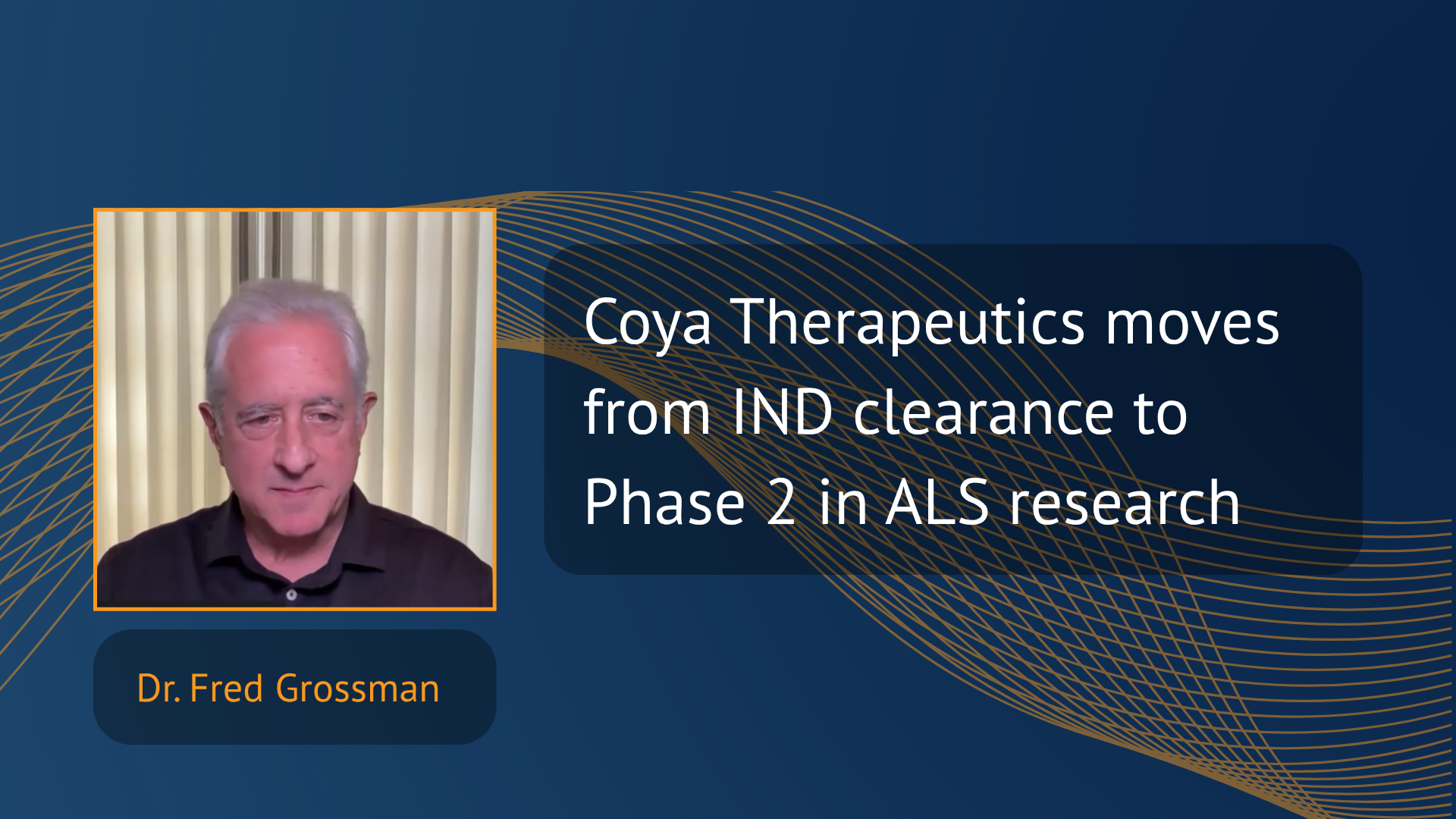
In this episode of Conversations That Matters, Dr. Fred Grossman, President and Chief Medical Officer of Coya Therapeutics, a clinical stage biotech company developing therapies intended to enhance regulatory T-cell functions to target systemic inflammation and neuroinflammation, joins Solomon Wilcots in discussing new clinical developments the company has made. Today, he is here to share an important update on the company’s lead candidate, Coya 302, being evaluated in ALS or Lou Gehrig’s disease and what it could mean for people living with ALS.
Moving Upstream in ALS Treatment With Immune Modulation
Solomon Wilcots: You got some exciting things happening with your company. Let’s get started by maybe sharing with us how Coya’s approach to treating ALS is different from what other companies have been developing in the past.
Dr. Fred Grossman: Well, look, ALS is a pretty devastating disease. There aren’t adequate treatments at this point. There have been a lot of recent failures—companies trying to develop therapies because they’re focusing on very specific targets, downstream targets, molecular targets. At Coya, we’re focusing on something that’s extremely fundamental to ALS, and that is lowering inflammation via regulatory T cells. This is an important concept, because in ALS, patients have very high inflammation. What that is causing are these toxic oxidative stress molecules that are killing motor neurons. We’ll talk about that in a moment. But when you kill motor neurons, you’re creating paralysis.
What we’ve developed is a biologic therapy combining two potent biologic therapies in a subcutaneous injection. Why that’s important is that patients can self-inject or caretakers can inject. But what’s critical here is that in patients with ALS, they have dysfunctional regulatory T-cells. Why is that important? It’s important because regulatory T cells tamp down inflammation. In patients with ALS, they have dysfunctional regulatory T cells, meaning they have fewer regulatory T cells and those that are there are not suppressing inflammation. So, patients have high inflammation, which is causing this progressive disease.
Our therapy, which we will be studying, has the potential to stop that from happening because we’ve already generated data that shows that when this is given, regulatory T cell numbers increase, and inflammatory suppression also increases. We’re reducing inflammation and we have data that shows that. Also importantly, we’ve given it to patients. When we’ve given this to ALS patients, they stop progressing. That’s a huge thing because as you know, and I know we’ll talk about this, patients with ALS progress and often die within five years. This is important, and we’re really excited to put this therapy to the test in a controlled study and hopefully, if we see efficacy, get this eventually approved because there aren’t any adequate treatments for these patients.
From Early Data to a Definitive Clinical Study
Solomon Wilcots: Fred, this is great news. Kind of walk us through it—the IND clearance by the FDA to begin a phase two trial for Coya 302 in ALS. Where are you guys at in your approach?
Dr. Fred Grossman: Well, we’ve just been given approval to proceed through the IND process—that’s the investigational new drug application. In order to move forward in a study with a new potential therapy, you have to get FDA approval. The FDA has approved us to move forward based on the potential and safety. This is important because this is a big trial. This is going to be a trial that includes 25 major sites across the United States and Canada to test two doses of this therapy versus placebo in a controlled way, that’s a definitive study. If we can reproduce what we’ve seen in the patients exposed to this therapy, we’re going to move forward and try to get this approved through discussions and applications with the FDA.
Why ALS Progression Is So Devastating for Families
Solomon Wilcots: Wow, this is very exciting. ALS is a devastating disease that touches many people’s lives—even famous celebrities, great baseball players like Lou Gehrig, Stephen Hawking, even NFL player Steve Gleason has battled ALS. Can you help us understand why this disease has such a profound impact on patients and their families?
Dr. Fred Grossman: Well, even before I start, I will say that our company has key people who are associated with it and who are employees of the company who either themselves have been affected with ALS or carry the gene. I think you may have met one person associated with our company or who has family members. There’s this real devotion to try to get some kind of therapy out there that can help these patients.
Now, what happens with patients with ALS? The motor neurons start to die. When those motor neurons die, the muscles become paralyzed. While the speed with which that happens varies, patients will die typically within a five-year period, and it’s a progression. They go through various stages. It could start with paralysis of a single muscle and then progress to affect swallowing, speech, and full paralysis of voluntary movements. As you can see, people become more and more dependent—not only on caregivers and family, but on devices to help them with daily living, allowing them to eat. Eventually these patients become fully paralyzed, and it affects their respiratory muscles. That’s unfortunately what causes death.
This is really a very serious disease for which there aren’t adequate treatments, and we’re really excited to get this started so we can begin recruiting patients imminently in this study.
Solomon Wilcots: Well, Fred, we want to thank you for taking the time to join us. We want to wish you and everyone with Coya Therapeutics the utmost success as you go into your clinical trial. We’re going to continue to stay in touch with you, continue to share this story with as many people as possible who really want to understand how you’re working vigorously to bring about new therapeutics for ALS patients and their family members. Thank you for joining us again.
Dr. Fred Grossman: Thank you, Solomon. We look forward to updating you as we progress.
Solomon Wilcots: All right, take care now.