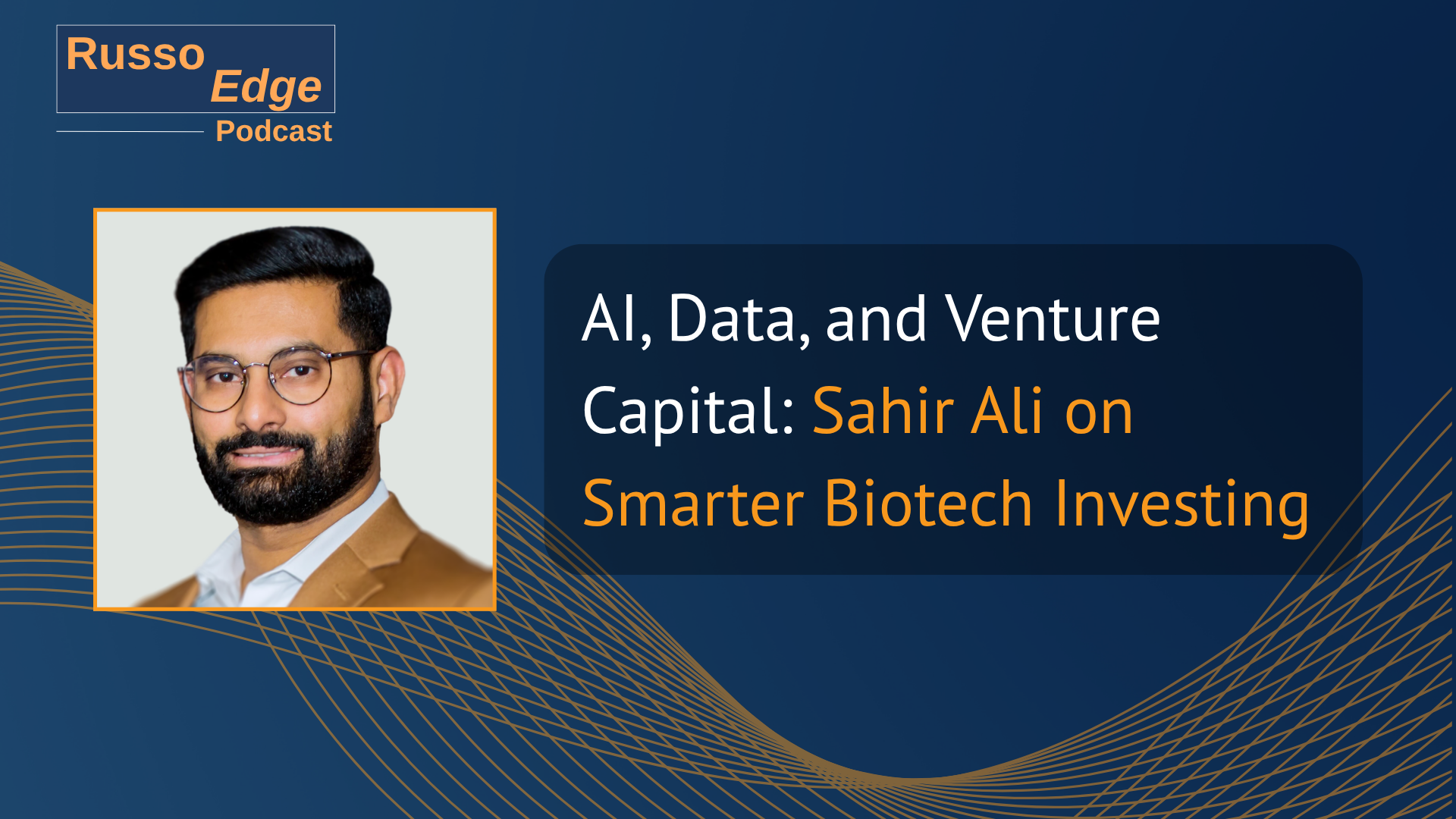
In this episode of the Russo Edge podcast, Solomon speaks with Sahir Ali, scientist, entrepreneur, and the founder and solo general partner of Modi Ventures. Sahir has spent his entire career at the cutting edge of technology and biotech. From coding software as a teenager, working on Wall Street, AI research and cancer labs, to launching a successful e-commerce company. He’s taken a non-traditional path into biotech venture capital. Now, starting Modi Ventures, he’s pioneering an investment strategy in what he calls BioStack, where advances in digital technology and biology converge to reinvent healthcare. Whether you’re building a life science company or backing one. This conversation is about what it takes to win.
The Outsider Path That Converged Into Modi Ventures
Solomon Wilcots: Sahir, welcome to the Russo Edge Podcast. How you doing today?
Sahir Ali: Thank you for having me, I’m really excited. Thanks Solomon.
Solomon Wilcots: Well, great to have you as well. Let’s get started by telling your story. You’ve had a unique path and of course, you’ve called yourself an outsider and you even describe yourself as a parallel entrepreneur because you are doing so many different things all at once. Tell us a little bit more about that.
Sahir Ali: Yeah, so this parallel entrepreneur term comes from Nubar, at least that’s what I first heard. And it really defines the immigrant mindset because you’re just trying to see what will stick. So, any opportunity you get, you tend to sort of grab it. That’s kind of what happened in my case. Coming into the country, I got myself into Dean Kamen’s robotics program, which gave me the exposure. I became highly technical and luckily, I could code really, really well, even before I was 15, 16, which led to my entrance into Wall Street early.
At the same time, I also picked up Salesforce.com, which was early those days with my brother involved in that e-commerce company. At the same time, I started doing research at the intersection of AI and cancer. If you think about these pathways, they kind of stuck with me. And at some point, they started converging together, which led to Modi Ventures. But ultimately, I call this parallel entrepreneurship because I am scientifically trained, I am an entrepreneur, but I also have a very quantitative mindset in how I think about the world.
Engineering Life and Rethinking Cures Through the BioStack
Solomon Wilcots: Very comprehensive. Every venture fund has its thesis, right, a lens for how they invest. In your case, you talk about something called the BioStack. Now, what is the Bio Stack and how does it guide your investment strategy with Modi Ventures?
Sahir Ali: Yeah, I like to think about where some of the technologies are sort of converging and that typically tends to give an opportunity for us to think about the next 10, 15, 20-year horizon. As venture capitalists, that’s sort of the horizon you have, so you can start to make some bets today. When it comes to biology, medicine over the last two decades, there are three core technologies, in my opinion, that have been converging for some time now. One of those is the rise of digital biology and synthetic biology. What I mean by that is since Human Genome Project, we have been digitizing the stack which I call the Biostack as you said. When you have such an amount of data that is digitized, you can now start to think about to read, write, and reprogramming the entire biostatk.
What that ultimately leads us to is a paradigm shift on how we think about disease. How do we understand disease? How do we treat disease? But also, we start to think about cures. We’ve just not had that many cures. So ultimately that’s the thesis of Modi Ventures. What’s exciting is that it allows us to think about how we ultimately engineer life itself. That’s the core broad thesis.
Quantifying Biotech Risk and Structuring Portfolios to Reduce Volatility
Solomon Wilcots: Well, it’s really great information. Biotech is famously high risk, but it’s also high reward. Some say it can cost over $2 billion to bring a new drug to market and most drug programs still fail. As an investor, how do you manage those risks?
Sahir Ali: I tend to think a little bit more quantitatively about that and folks who are in the biotech quantitative space would recognize Andrew Low’s work in this space where he identified that in biotech, in an asset that’s $2 billion, 14 years, that volatility is more than 200-300% and so who’s going invest in such a volatile asset.
But if you start to combine a few of those in the right area, such as rare disease, you can actually bring the volatility down. Over the last 10 years, we’ve seen the rise of funds going after rare disease and that’s the whole idea. However, if we take a step back, yes, there’s volatility but there are some deterministic outcomes that can happen. For example, when an asset enters phase one, we start to see some sort of deterministic outcomes. There are some biopharma companies who will want to pick up that asset at a phase one. Phase two particularly where most of these assets would exit, either IPO or get acquired. Compared to tech investment, the company can go to series A, B, C, D, but there aren’t any deterministic outcomes as such.
But in this space, yes, the volatility is high. But at phase two, you can see there will be some deterministic outcomes. At phase three, you could actually benefit from some royalty type deals and things like that. So that’s how we think about that, at least on the pure biotech side. Of course, we also do devices and purely in physical place, the different models apply. But when it comes to therapeutics, that’s how we tend to think about things.
What Makes Academic Scientists Effective Biotech CEOs
Solomon Wilcots: So what about the founders themselves? You worked with academic scientists who have turned CEOs. In your view, what qualities make great biotech founders or CEOs in that leadership role?
Sahir Ali: First, it just all starts with intellectual honesty and humility. You just have to understand that a startup is a path that is a curvy path and you don’t know everything. The number one thing, particularly scientists who are turning CEOs and founders, is they have to recognize not only their own limitations, but the ability to be coachable and stay humble but have tenacity to navigate the curvy parts. It’s not going to be easy, but that’s what a startup is, but their rewards could be much higher.
The second part is the scientific depth. In the therapeutic space, it’s just required. You can’t fake it till you make it in this space, particularly when we’re talking about this space even in devices, so that’s important. I think third most important thing according to me and investors is ability to tell the narrative. In particularly the biotech world, I think there’s much to be desired. How to tell your story so that investors understand, although they may not be as sophisticated as you are because you spent seven years in your PhD postdoc doing this work. Storytelling to me becomes very, very important. As I mentioned that ability to kind of build the right team around, which is part of the mojo to attract the right amount of people. I think these are some of the things that I tend to look for.
Ultimately, in an early-stage company, you’re making some bets on the signs on what will work out or inhuman or the device will have commercial success. But the number one thing you’re looking for is the team. There’s the right founding team, are they going to be the one team that’s going to take you across? So the founder is very important, and what characteristics they bring to the table.
The First Three Pitch Tests: Problem, Timing, and Founder Fit
Solomon Wilcots: Absolutely. Now, when a founder is pitching you, what’s the first thing that you want to know? And what is your mental model for pressure testing early companies?
Sahir Ali: Yeah, the very first question always comes up is, what problem are you really solving for? Is this a solution looking for a problem? I mean, of course, this can broadly apply to anything, really from tech to any investment. Second is why now? Sometimes some things are just way out of its time. You have to be able to say, what are you solving for? And why is it the right time today? And also, why you? These are some really top-level, high-level things that you just have to grab an investor’s attention, I would say in the first 10 to 15 minutes of the pitch, even I would say sooner. So those are the three things that apply basically to devices, therapeutics and all.
But if we were to say in biotech particularly, then the science, the mechanism of action, where’s the IP from? What is the unmet need in the market? Is this yet another way of doing something or is this going to be a complete game changer? What does a regulatory pathway look like? I think one of the things that I’m really critically looking for early is do founders understand the regulatory pathways? And I think some tend to brush that over for later. I really like to see what the pathway would be if it’s a complete brand-new way of doing things, particularly even a recruitment of the patients and all. I think these are challenges that I think up front, having an understanding on how to mitigate that is also very important.
And again, ideas that are a dime a dozen comes down to execution. Yeah, do you have the right team? And if you’re the first-time founder, you must have people around you in the advisory or bring somebody on to say, I compensate for lack of experience, but I am the person to be able to do this. Again, high level framework, which roughly applies to really anyone pitching in the venture space, not just biotech. But here you have to focus on science, IP, a lot more, and the patient populations, all of that, but giving a high-level framework that applies across what I call the Biostack.
Solomon Wilcots: There you go. A lot of work making sure that all the bases are covered well. Not every investor is ready to back a preclinical or a biotech platform company. So how can founders tailor their pitch to fit maybe different capital appetites? And how do you spot what is a feature versus a real company?
Sahir Ali: All right, so let me start with in biotech therapeutics. Data just speaks for itself. You got to think about how I have a strong data package, strong in vivo proof concept for the lead asset. Show clear superiority of data versus what’s out there. Data always speak for itself; this is not tech investment where you can do thought experiments on network effects and all. Now, of course, we also do devices and a few other things. In those cases, a little bit of framework applies.
One thing that just applies to everybody is, do you have a clear sense of milestones? And have you done financial modeling on how much capital do you need compared to those milestones? And is it that you need to get into IND? Is it that, you need to get a prototype and get a first beta testing to a milestone? These are very milestone driven and you raise accordingly and always raise a bit more as there’s the curvy path. I think that the team is very important and you always have to think about the valuation of the company and what investors you bring on.
Especially in early stage, you must have investors who are value add beyond just the check. Sometimes my advice to founders is, investors can also make or break the company. So, the right set of investors, leads, indicate these are very important. Also, given the market condition, you have to give yourself a lot of time to be able to raise capital. And having that understanding on what milestone I need to hit and being keenly aware of what investors are looking for. Having early conversations, working through on potential investors and what they’re looking for is part of a good startup’s job, is not to get surprised and leaving that towards the end. Always be proactive on what is it that you need to be able to do. You might have your own senses of where things need to be, but ultimately capital drives everything. Whatever the investors are saying, I think at some point you do have to align with that.
Why Us, Why Now: Standing Out in a Tough Fundraising Market
Solomon Wilcots: Well, you just recently closed out your second fund raising roughly what, $88 million at a time when fundraising for new venture funds is not that easy, but yet you managed to break through as a new fundraiser, especially as you expand into Europe. What made your pitch to investors really stand out and how did your portfolio theory approach play into that?
Sahir Ali: Right. So that’s a good question. Why us? Again, let me just put myself in the founder seat and say why us and why now? And let me walk you through on that. As I was indicating with the biostack and the biospectrum, these are the two axes for us. I am driven very quantitatively, and I thought there was an opportunity to apply a form of modern portfolio theory, where we lay out the type of assets we want to pick up on that biospectrum from an idea turning out from a lab to IND to phase one to phase two to phase three and then post market. In that biospectrum, we can pick up assets that are funds like LP positions, for example, flagship pioneering, they build the companies and take it all the way to the market sometimes.
We can invest in funds that are royalty-based funds at phase three. We invest in companies who might be at phase one going into phase two. We invest in companies that are just spinning out. We invest in companies there are devices who are early but could have a significant inflection point. So, you can start to see that we place these bets at different volatility and different returns or profiles so that is kind of the part and parcel of modern portfolio theory. And if you can do that in a bit of an uncorrelated way, you actually can start to bend the curve.
I think that was, or at least according to our investors, was a very fresh take on how to actually play in this space. We were lucky and blessed that about three years ago, we launched with the Proof-of-Concept Fund One. We made the right investments, and we’ve done well with that. And luckily this year, we were able to raise a close to $90 million fund, I would call it given the market condition, in a very short time.
The Rise of the Texan Biotech Hub
Solomon Wilcots: Sahir, I’m going to tell you, man, that’s pretty heavy stuff you got going there. And the talents and the different angles in which you look to approach and solve problems, I think is phenomenal. I know that you’re based in Houston, home to the world’s largest medical center. And you said that it’s still an underrated ecosystem for life science. So what’s happening there right now and what excites you the most about what’s going on?
Sahir Ali: Yeah, I mean, I think it’s one of those things where you just have to come to Houston and see it. The Texas Medical Center, as TMC, is the largest medical complex in the world. About 120,000 people come and work at this just a small district.
It is the eighth largest businesses in the United States. There’s lots of hospitals, research, R&D, best care, one of the best cancer hospitals in the world, a Nobel laureate of immunotherapy, all sort of Science, Baylor, the best heart surgeries, everything is happening her. What has typically been a bit lacking was this this other arc, which was the life sciences. How do we do innovation and then bring him out to commercialization? So, over the last five to six years at least, the Texas Medical Center, the state of Texas and all the member institutions that are in Houston hospitals have some amazing initiatives
Solomon Wilcots: Well, you should know, Sahir, I have been on the campus at Rice University. I’ve seen the ecosystem up close and personal, and I just think it’s phenomenal. The talent, the brains, the resources that are all collected in one place to help move science forward. I think it is a wonderful thing, and you guys are just gonna continue to do some really great things in that space.
Sahir Ali: Yeah, let me add one more thing that you mentioned, Rice University has a biotech launch pad, which is an incubator and they build companies. Fortunately, I’m on the board of that and we’re partners there. But yeah, that’s another example of what’s going on in Houston.
The Next Decade of Healthcare: Precision Therapies and AI-Driven Care
Solomon Wilcots: That’s right, really good stuff. Let’s zoom out a little bit, take a more big picture approach. With all of these technologies coming together, what do you think healthcare will look like say in the next five to 10 years? And how do you see this biotech revolution sort of unfolding over that period of time over the next decade or so?
Sahir Ali: I think in the short term, we are starting to see therapies that are more precise in nature. It gives causality to the disease, so we can really be very precise. In some cases, thinking about curing disease. So, in December 2023, sickle cell through CRISPR, we just turn off the disease at the DNA level. It’s a cure. I’m hoping we get a lot more of these trials getting in there. I’m hope over the next five years, we sell in gene therapy, which has a big promise, but we have manufacturing issues, so we can start to kind of think about how we handle those challenges.
On the AI front, in the care delivery, AI is raring to go. It’s already making a big difference when it comes to physician burnout through ambient AI, they start to do better diagnosis, better prognosis, these digital biomarker tools enabled by AI. It’s a huge promise there and it can move the needle forward. Also, the biggest opportunity is in preventative care and ability to provide data to consumers based on their own body.
For example, wearables are I think in the next five years will play even a bigger role. I think we’ll see with these consumer wearables, there will be a consolidation at some point. Right now, we have the Fitbits and the Aura and all of that. I feel over the five years, there will some consolidation where wearing the device can do it all. I’m hoping that’s where we going to go. All I’m saying is that we are going from analog world of bio and medicine to a digitized world from not just how we do drugs discovery and development, but how we deliver care. That’s the hope in the near and long-term future.
Solomon Wilcots: Really promising stuff. Okay, one last question here. This is for founders and investors who might be listening to this conversation that we’re having. If there was one piece of advice that they could take away from this conversation, what would that be?
Sahir Ali: I would say that to be excited and passionate about what you’re doing and if you are, you’ll always find a way. Stay with it, give it a hundred percent but you got to do it out of passion, you have got to find that passion and it will drive everything else. And stay humble, stay intellectually honest.
Solomon Wilcots: I love it. Absolutely great advice. We want to give a big thank you to Sahir Ali for joining us today. From parallel entrepreneurship to pioneer tech bio investing, his work is bridging two worlds to push healthcare forward. It’s a masterclass and how data and biology together can really accelerate innovation and how founders and investors can navigate this new frontier. I’m Solomon Wilcots everyone. Thank you for joining us today.
The Russo Edge Podcast is hosted by Solomon Wilcots and features candid conversations at the intersection of biotech, healthcare, and innovation, spotlighting leaders, scientists, and investors moving medicine forward. The following transcript has been edited for clarity.