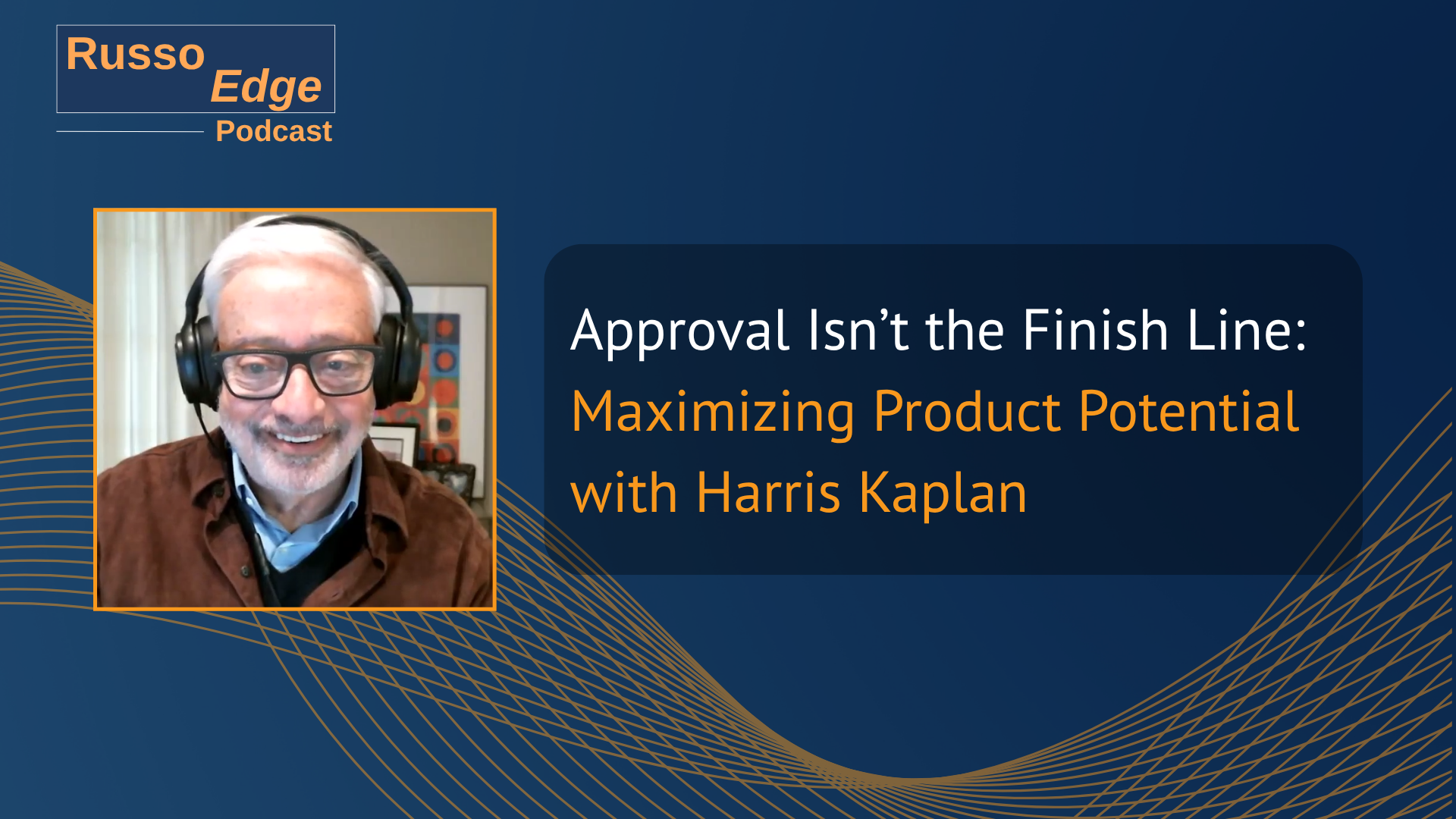
In life sciences, FDA approval is often treated as the finish line. But approval does not guarantee that physicians will prescribe a product, payers will cover it or patients will use it. Harris Kaplan, Managing Partner of Litmys and author of Approval Is Not Adoption, joins Solomon Wilcots on the Russo Edge to discuss the gap between regulatory approval and real-world adoption.
Drawing on more than four decades in the industry and work on more than 125 pharmaceutical, biotech, medical device and diagnostic products, Kaplan explains why companies need to weigh commercial questions much earlier in development. He outlines the three questions that drive adoption, his RAMPx model for assessing market potential early, and why the industry needs to play chess with every stakeholder rather than checkers with one.
Solomon Wilcots: Harris, welcome to the Russo Edge. It’s great to have you with us today. How are you doing?
Harris Kaplan: I’m doing great.
What It Really Takes to Drive Adoption
Solomon Wilcots: You’ve spent more than four decades working across the life sciences industry and have been involved with more than 125 products. What first drew you to the commercial side of healthcare?
Harris Kaplan: I’ve always been interested in how people make decisions, and what really influences and drives them. In healthcare, the consequences are significant. These are drugs that impact people’s lives. This is not about a new flavor of yogurt.
Solomon Wilcots: That’s right.
Harris Kaplan: Companies spend a fortune developing products, and healthcare matters. We’re trying to do things that help people extend their lives and live better lives. What better avocation than that? And on top of that, I actually get paid for doing it. It doesn’t get much better.
Solomon Wilcots: You’ve said that well over half of new products fail to live up to expectations. After seeing so many launches firsthand, why do you think the industry continues to get commercialization wrong?
Harris Kaplan: I think “wrong” may be a little too harsh. Maybe the better question is how we can make commercialization more effective. The starting point is that we too often confuse enthusiasm for the science with adoption. The assumption is that if people are enthusiastic about a product and think it’s better, they’ll adopt it. In reality, there’s a real gap there.
Companies also tend to organize around clinical development and getting FDA approval. Increasingly, FDA approval doesn’t guarantee that a product will be successful, because commercial success requires a different set of decisions and a different set of stakeholders. As more stakeholders get involved, there’s more opportunity for people whose objectives aren’t fully aligned to get in the way of a product’s success, even though everybody is well-meaning individually.
Solomon Wilcots: Getting people to work collaboratively toward the same goals can be challenging. You describe three basic questions behind adoption: How much better is the new product? How difficult is it to switch? And how willing is someone to take the risk of being an early adopter? Why are those questions so important?
Harris Kaplan: Those questions don’t just apply to a drug. You’d ask the same questions buying a new car. How much better does something need to be before you’re willing to change? As you can tell by my hair, I’m not someone in his thirties. Until a year and a half ago, I had an iPhone X. I kept saying I needed to replace it, and a colleague kept asking, “What are you going to do with a 17 that you can’t do with the X?” I couldn’t answer that. But when they gave it to us for free, I said, okay, there I go.
A product needs to be sufficiently better that someone says, wait a second, maybe I ought to change my behavior. Then it needs to be easy, and the data needs to be strong enough that someone’s willing to do it.
The biggest challenge, and one that’s often not discussed in our industry, is that 80% of physicians are now employed, by a health plan or a hospital, and they’re paid significant productivity bonuses. So they’re weighing whether to sit down and learn about a new product. Is it better enough? Is the juice worth the squeeze? Because in that time, I could see two patients.
Solomon Wilcots: There you go.
Harris Kaplan: And I make money doing that. I don’t make money seeing a sales rep.
Why Approval Is Not Adoption
Solomon Wilcots: That’s a product line that’s always being evaluated. That brings us to your new book, Approval Is Not Adoption. What does the title mean, and why did you feel this was the right time to write it?
Harris Kaplan: I wrote the book because I think hundreds of millions of dollars are being wasted right now developing products that probably won’t be successful commercially. As of a few months ago, there were something like 39 GLP-1s for obesity in clinical development. Yes, we have a weight problem, but you can’t tell me all of those are going to be successful.
I’ve seen too many promising products reach the market without anyone answering what it really takes to get them adopted. The FDA only cares about whether a drug is safe and effective. That doesn’t say it’s better, that it will be easy to adopt or that patients will want it. I saw a gap, so I wrote a book about it. Jeremy Levin, one of the endorsers, sent me a note after reading it saying this is a problem everybody knows about, but they continue to kick it down the road.
Solomon Wilcots: That’s right. It’s amazing how we continue to do that.
You’ve made the point that the criteria for FDA approval are not necessarily the criteria that determine whether a product succeeds in the real world. Can you give us an example of how those two standards can diverge?
Harris Kaplan: I’ll use a product from the ophthalmic space because it’s easy to get your head around. The FDA wanted to see that patients could read one more line on an eye chart. For the retinal surgeons administering the product, one more line on an eye chart really matters.
But when you talk to the payers, who insure these patients, their question is whether those people will be able to work because of that improvement. If they can work, their employers pay a premium for their health insurance. And when you talk to patients with the condition, their worry is, “Am I going to be able to drive? Am I going to be able to keep my license?”
So the criteria that get you approved don’t necessarily line up with what payers or patients need. In a number of cases, they don’t even line up with physicians. Companies sometimes don’t realize that physicians are really their sales force. A doctor says, “Harris, you need to lose 15 pounds. Your cholesterol’s too high. Stop eating desserts and eat more protein.”
Solomon Wilcots: It’s a point of sale, isn’t it?
Harris Kaplan: It is a point of sale. The product needs to be easy for a physician to sell to their patients. Or if a company is running a TV ad, what benefits will make someone say, “I ought to find out about that and check with my doctor”? The trial establishes that a product works and is safe. It doesn’t establish whether it will be used and accepted. A lot of products have been approved, and people just shrugged.
Testing Market Potential Across Every Stakeholder
Solomon Wilcots: So there’s no movement. The product sits on the shelf, doctors aren’t prescribing it, and the model stagnates. You developed the RAMPx model to assess a product’s commercial potential very early in development. What does that framework look at, and what can companies learn before they’ve invested years and enormous amounts of capital into a program?
Harris Kaplan: I’m a marketing person by background. RAMP stands for Realistic Assessment of Market Potential. The idea is to give companies, while a drug is still early in clinical development, a litmus test of how it will be received based on the criteria they’re developing it against, and to identify early what headwinds they’ll run into. The model addresses the three questions we talked about: How much better is the product? How easy will it be to adopt? How willing will someone be to adopt it? It looks at those across 12 different factors, and it delivers feedback while something can still be done.
Here’s an example we’re working on right now. We were given a target product profile, the document companies use to set their goals.
Solomon Wilcots: Kind of like your X’s and O’s, your game plan.
Harris Kaplan: You got it. We took it out and talked to physicians and payers. The product was dosed three times a day, and the payers said, “We’re solving one problem but creating another, because nobody is going to take a drug three times a day.” Physicians said the same thing.
The venture capitalist funding this very small project told the client team he was going to pass. When they asked why, he said a three-times-a-day drug for a chronic, non-symptomatic condition isn’t going to work. A couple of weeks later, they came back and said they thought they could make it once a day. We went back to literally the same physicians and payers, and they said once a day would be a significant improvement and they’d be willing to prescribe it. As we speak, the VC is putting together a term sheet.
The benefit is that this product is just going into Phase 2, so they can still make those changes. That was the whole idea behind the RAMP model. Rather than throwing it over the transom to commercial and saying, “You figure it out,” how do we make sure the drug being developed will in fact be successful? That’s why I developed it, and candidly, why I wrote the book.
Solomon Wilcots: Great explanation. It’s clearly a model that works, solving problems as the product is being built. You’ve said the industry often plays checkers when it should be playing chess. I love the analogy. Physicians, patients, payers, PBMs, advocacy groups and health systems all influence one another. What does it mean to look at the entire field rather than just one stakeholder at a time?
Harris Kaplan: We should be interviewing you, because you just answered the question. Playing checkers is a smaller company developing a drug and saying, let’s focus on approval, or on the next milestone that increases our valuation and helps us get funding. Commercial gets pushed way down the road.
Chess works as a metaphor because there are multiple stakeholders. An hour and a half ago, I spoke with one of the most senior people at one of the largest PBMs. He said companies don’t come to them early enough to ask how they’ll look at a product and what they need to see to grant the reimbursement the company is looking for.
Companies also rely very heavily on key opinion leaders. The challenge is that KOLs increasingly practice in academic settings, with people around them who deal with insurance companies. If you’re in an independent practice, and especially if you’re an employee, you don’t have time for that. So we bring in input from community-based physicians and from patients, put it all in front of a client at the same time and ask, “What do you want to do?” It doesn’t mean you can meet every endpoint they want or run every trial their way. But there’s a difference between stumbling into something and deciding, “This is what we’re going to do.”
Commercial Thinking From Day One
Solomon Wilcots: Great stuff. If a biotech CEO or product leader reads Approval Is Not Adoption, what is the biggest change you hope they make in the way they develop and commercialize new products?
Harris Kaplan: My biggest hope is that they take the book cover, have it made into an 8×10 and put it on their desk. Even if they don’t read the book, the title is basically the gist of it.
The other thing would be to start thinking about these decisions earlier and earlier, because your opportunities to change a drug from a clinical development point of view disappear pretty quickly. Which endpoints you’ll have in a trial, which patients you’ll study, what your messaging will be. I’ve often told clients that instead of a target product profile, we should build the detail aid your sales force will take into the field, and do it while the drug is still very early. Get that feedback, then assess what it means and what evidence you need to generate.
That also gives you a more realistic sense of what it will take to turn the product into a commercial success, so investors aren’t disappointed by the results and you’re more realistic about what you can achieve and by when.
Solomon Wilcots: We recommend everyone get this book and read it: Approval Is Not Adoption. Harris, thank you for joining us and for helping us understand why getting a product approved is only part of the journey.
Commercial success depends on much more, from physician behavior and patient demand to payer access and how all of those stakeholders interact with one another. A big thank you to Harris Kaplan, Managing Partner of Litmys and author of Approval Is Not Adoption, for joining us right here on the Russo Edge. Thank you, Harris.
The Russo Edge Podcast is hosted by Solomon Wilcots and features candid conversations at the intersection of biotech, healthcare, and innovation, spotlighting leaders, scientists, and investors moving medicine forward. The following transcript has been edited for clarity.