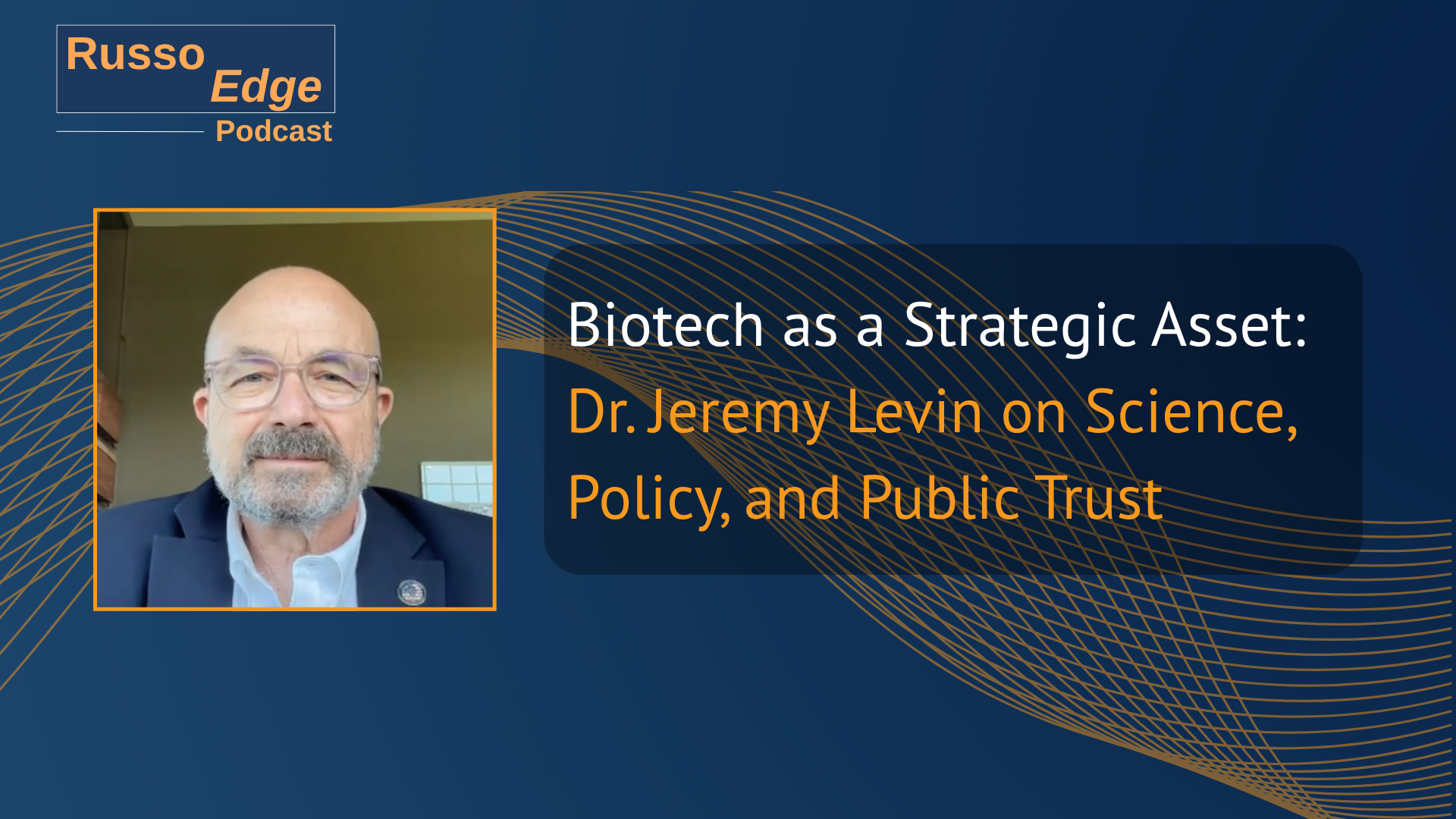
Biotechnology has changed what is possible in medicine. It has helped turn once fatal diseases into manageable conditions and opened the door to treatment that would have seemed impossible a generation ago. But what happens when science keeps advancing while public trust begins to break down?
The innovation is real and the promise for patients is enormous. But the system that supports it, from research institutions and capital markets to public confidence, is under pressure. If biotech is one of America’s most important strategic assets, what must we do now to protect it and rebuild trust?
Solomon Wilcots: Today we’re joined by Dr. Jeremy Levin, co-founder and executive chairman of Ovid Therapeutics, former CEO of Teva, former chair of BIO and a longtime biopharma leader whose career has included senior roles at Bristol-Myers Squibb and Novartis.
Jeremy’s own story began far from the boardroom. His family were refugees and his life was changed by people who saw potential in him and took a chance. That experience helped shape how he thinks about science, purpose, and responsibility. His new book is Biotech in the Balance: Saving a Strategic Industry in an Age of Distrust. It makes the case that biotech’s future depends not only on scientific progress, but on public trust, patient focus, and a renewed commitment to the people the industry serves.
Jeremy, welcome to the Russo Edge. It’s great to have you. How are you doing today?
Dr. Jeremy Levin: Solomon, great pleasure being with you today. Thank you for having me.
The Moment Biotech Became a Calling
Solomon Wilcots: Well, I got to tell you, I’m excited about today’s conversation. Let’s go ahead and get started. And before we get to the book, I want to start with the person behind it. Your life began with upheaval, but it was also shaped by people who took a chance on you. They saw something special in you. Now, how did that shape the leader that you have become?
Dr. Jeremy Levin: That is such a question, Solomon. I think there are a couple of things that one should draw from one’s history. One is that teachers have a remarkable influence on you. And because I couldn’t read, I had the great benefit of meeting somebody called Mrs. Capel, who took the time to sit down with me to understand that it wasn’t that I wasn’t reading, I was just more interested in what was going on in the bush. I could track, I could wrangle cattle and sheep, and reading just wasn’t up there. But she taught me something. She taught me that if you look beyond the surface, you’ll see something else.
The second was Stuart Hampshire. Stuart Hampshire at Oxford, I met by complete chance. Stuart was the head of Wadham College. He knew I had terrible grades in high school. My grades were two Cs and two Ds. And yet Stuart listened to me as a person. He asked me what I was interested in. And this extraordinary philosopher took an interest in trying to bring what was inside me out. I’ve never forgotten that. Those two people exemplify what I think we all should do as leaders. It’s not about their success. They were leaders in their own particular world.
It’s about how you bring out what’s best in everybody else. How do you make them win? How do you open doors so that they can walk through? Sometimes people don’t walk through, but if they do, then you should be there to support them.
Solomon Wilcots: Yeah, I think it’s amazing how they saw the curiosity that you had, which you and I both know is the key to learning. You had that innately and they were able to spark it and kindle it. And it’s great that they saw what was special lying inside of you. And you’re trained as a physician and as a scientist. So, when did you first see biotech as far more than medicine and as a way to build something even bigger for patients?
Dr. Jeremy Levin: This was quite a revelation. I had every expectation that my life would probably end up as a game ranger in the center of Africa. And then once that didn’t happen, then I was going to be a scientist looking at the thermodynamics of DNA. And then one day I met a patient with xeroderma pigmentosum. And I asked the question, could I find a way to try and cure this patient? Was there something there? I never answered it at that time.
But going to Cambridge and leaving behind the pure science that was the delight that I had at Oxford, I entered a world where, in fact, biotech came to me. I was asked to look at a new medicine. It was, at the time, a revolutionary medicine.It was a remarkable medicine whose origins lay in observations made on peptides found in Brazilian pit viper venom and which ultimately led to the development of captopril. And I wrote a thesis on it. I became captivated by the idea that you could begin with a biological observation, understand the mechanism, design a molecule, and create a medicine directed at a specific human target.
And I determined at that time, at that moment, that I had to see what this entire world of biotech was in the United States. And so, it wasn’t one thing, it was several things and each one layered into a choice. I made those choices.
Solomon Wilcots: It sounds like all of my favorite teachers that I’ve had in life, both in and outside the classroom. So, I want to ask you this – the science in biotech has never been more powerful, so what breakthroughs give you the most hope right now?
Dr. Jeremy Levin: Wow. That is such an extraordinary question. I am beside myself at times in wonder as to what we’re seeing being laid out in front of us, Solomon. Imagine a world where it was just remarkable that you had an antibiotic that just cured you like that of an infection.
Well, that’s not so long ago, that was really at the end of the Second World War when Penicillin burst onto the scene. Now you fast forward to today. What do we have? We have cancers being knocked back – really great. We have chronic diseases that otherwise would kill us, HIV, an unimaginable disorder, but now can be completely constrained. These are, in and of themselves, they represent a huge advance in humankind’s care.
And then you have only to think about what would have happened without the vaccines that Moderna, Pfizer, J&J, and others delivered at the time of COVID. All, let me be clear, all built on the back of biotechnology. Millions would have died had they not occurred. But that was just the door opener. Because what we see today, most recently, an extraordinary event in cancer. This is very exciting – a horribly debilitating, awful cancer, pancreatic cancer, looks like we’re enroute to knocking it back. For the first time, we’re beginning to see outcomes in selected patients that would have been unimaginable only a few years ago. That is an extraordinary illustration of what biotechnology can accomplish. And that’s all because we’re building on science.
Why Biotech Is in the Balance
Solomon Wilcots: And Dr. Levin, that brings us to your new book, Biotech in the Balance: Saving a Strategic Industry in an Age of Distrust. Why was this book needed to be written right now at this present time?
Dr. Jeremy Levin: Solomon, against the backdrop of that remarkable tidal wave of innovation, America’s scientific innovation has never been stronger. We saw something else creeping in and beginning to erode the very foundations of biotech. And it became imperative for me because those things will destroy this industry from within if we don’t put a stop to it.
And what I mean by that is we’ve begun to see an erosion of the institutions that underpin scientific discovery. Massive reductions in the NIH. We see the first introduction of politicizing science, saying that grants can’t be given unless somebody agrees with a particular political stance. This is not an acceptable way to build the base.
Going on from that, we have begun to see what were, I thought initially, very necessary changes at the FDA, but executed in a fashion which was extraordinary. Approximately one-fifth of the FDA workforce departed over a remarkably short period.
In addition to which, 90% of all of the deeply experienced and committed individuals who had been there for years as leaders, gone within 18 months.
Then you look at something else. And that is the change in leadership, the change in direction. This institution built over many years, shapes the thinking not of the United States, but of the world as to how you develop drugs. So, my view is very constrained by what I was seeing here in the United States. And that was the fundamental erosion of the pillars of what had allowed biotech to thrive.
And by the way, I want to draw a clear distinction. Biotech is about innovation. Biotechnology and pharmaceutical companies perform different economic functions. Biotechnology repeatedly raises high-risk capital to create scientific innovation. Pharmaceutical companies industrialize, manufacture and distribute medicines at global scale. Both are indispensable, but they operate under very different economic models. Once you’ve innovated, you need some degree of predictability, i.e. developing through the FDA, so that investors can support it because biotech ultimately depends on enormous amounts of capital pouring in. That’s not the same as the pharmaceutical industry. They’ve never raised capital at all except debt, but that’s not relevant, so we need to divorce them.
This is why it was called Biotech in the Balance. It is not Pharma in the Balance. It is Biotech in the Balance. That innovation engine is at severe risk in this country.
Why Biotech Innovation Needs to Be Understood and Protected
Solomon Wilcots: Yeah, and you’ve also warned that biotech innovators are often blamed for drug pricing, so how do you explain the difference between creating a medicine and the system that determines what patients will actually pay for that medicine?
Dr. Jeremy Levin: Solomon, we have created one of the most complex systems in the world for pricing. However, we do have something pretty fundamental. We have patent expiry. When patents expire, there is no defense for trying to build thickets to defend that drug. So, my view on pricing is very straightforward. Pricing needs to reflect the extraordinary investment that goes into developing a drug. And in this instance, I’m talking about the small, innovative companies.
When that pricing is awarded, it means that the investors are encouraged to do another investment. When the patents are over, the price of that drug needs to plummet, as it should do, as it becomes generic. Now unfortunately, around this system, we’ve conflated many different things. We’ve conflated the fact that large companies selling billions of dollars every year of their product, frankly, are the same as the small companies. They’re not. They never have to raise capital, as I said before.
So, pricing for a large company is a very different discussion than pricing for a small company that won’t see its drug price for 10 years at all, if ever, if it’s not successful. So, I think what we need to acknowledge here is something very fundamental. The system we’ve built does not distinguish between the giants and the innovators. The giants are incredibly necessary, but the innovators are what are driving it, and they produce 70% of the drugs.
So now we come to a different layer of complexity. We have this strange duality, giants with no need to raise capital, little innovators who need capital. You then have something different. And that is the middleman. In our complex system, we have allowed something economically distortive to intervene. And that is the PBMs. These are layer upon layer upon layer upon layer of middlemen who take a piece of the action. A drug that exits a factory at one price can easily find itself doubled by the time it gets to a patient by virtue of these middlemen.
Solomon Wilcots: Yeah, that’s a great explanation. We want to thank you for your candor. I want to know why should Americans even think about biotech the way that we think about, say, energy or even defense or semiconductors? And what should we do now to protect its edge?
Dr. Jeremy Levin: Well, we have a choice. We have invested, in what is, in many cases, almost an invisible engine of innovation. People only see it when they go to the pharmacy. So, if you ask the average person what biotechnology means, they won’t largely be able to tell you. That story needs to be told. That story needs to be brought right the way out.
We shouldn’t simply have to rely on adverts talking about a drug and then immediately covering their concerns about the side effects and lawsuits. Rather, we should be asking the giants, these giant companies, to broadcast the wonder of these drugs generally. There is an opportunity for communicating in a way that is quite remarkable. Direct-to-consumer advertising, as practiced in countries such as the United States and New Zealand, is probably necessary, but it’s not necessarily desirable. What you really want is to say what we are trying to accomplish.
Now when people understand that, then that silent innovation engine becomes obvious. It becomes a pillar for health, it becomes a pillar for social cohesion, and a pillar for the economy, it becomes something just as important as any one of the fundamental industries in this country that are supported by large groups of people, and the reason why? It does something that the other industries don’t do. It saves lives, it builds economy. It means that your child with leukemia will live, won’t die.
This represents not just economic benefit, not just social benefit, but a moral benefit about the country, something that we should all recognize as having immense strategic national value. Biotechnology is not simply another industry. It is strategic national infrastructure. It determines whether a nation can respond to pandemics, attract scientific talent, sustain economic leadership, and develop the medicines of the future.
The 10 Commitments for Defending Biotech
Solomon Wilcots: I want you to talk real quickly about your 10 Commitments of Biotech and why it was important to make this practical and not just a warning. Give us just an overview of what those 10 Commitments are and why they are so very important.
Dr. Jeremy Levin: In 1947, J&J wrote the credo, four paragraphs. It was the birth of what we know as the modern pharmaceutical industry. But those four paragraphs underpinned an enormous truth. It was the commitment of that company to do good. Now what we see is a different moment. Our industry is far more sophisticated than it was then. We have many, many more stakeholders than we did then. We have a much more complex economy.
So, I wrote out 10 commitments, inspired in fact by the J&J credo, to modernize what it is that makes a new company in this giant, extraordinarily important industry. What is it that is the legs, the framework whereby they can operate? Because after all, we’ve seen what the credo has done. The credo walked America through the Tylenol crisis. The credo helped me, for example, when I walked through a similar crisis in France. It helped me provide a moral base for decision-making.
And that is what the 10 Commitments are. This is: How do we behave? How do we lead? What do we build? Why do we build it? And what do we expect out of it? So, they are actually quite aspirational. If we accomplish a few of them, then I feel we’ve done well.
The Ten Commitments of Biotechnology Leadership
From Dr. Jeremy Levin’s Biotech in the Balance, a framework for defending science, protecting patients, and building ethical biotech companies in a time of political, financial, and social pressure.
Commitment
Promise
What this means
1. We will defend facts and independent science.
Facts over politics, always
We reject political distortion of evidence, protect scientific independence, and speak plainly when evidence is distorted or suppressed.
2. We will put patient welfare ahead of political or financial convenience.
Patients before pressure
We never allow political or financial pressure to override patient need, safety, or clinical judgment—and leaders name that conflict plainly when it arises.
3. We will build resilient, ethical supply chains.
Supply is a moral duty
We design redundant, high-quality, accountable supply chains that protect patients and national resilience, including through BIOBUILD in practice.
4. We will practice radical transparency in political engagement.
No hidden influence
We disclose our positions, funding, and intent in political engagement, consistent with law and ethics.
5. We will back long-term science with long-term capital.
Fund the long arc
We align incentives and capital structures with scientific timelines, resisting quarterly pressure and premature hype.
6. We will build companies to outlast their founders.
Institutions over personalities
We build durable governance, succession, and culture so mission and values endure beyond any individual leader.
7. We will honor employees as citizens, not instruments.
People are not tools
We respect dignity, diversity, voice, and safety, and leaders speak out against intimidation, discrimination, or retaliation inside their own institutions.
8. We will share responsibility for global health equity.
Health is not a privilege
We expand access through partnerships, differentiated access models, and capacity-building—without exploitation.
9. We will integrate biosecurity and dual-use responsibility into the core.
Safety is built in
We embed dual-use review, safeguards, and reporting across research, data, and manufacturing—not as compliance, but as duty.
10. We will tell the truth about risk, uncertainty, and limits.
Candor earns trust
Leaders speak plainly about uncertainty, failure, and limits—to patients, regulators, investors, and the public—recognizing that silence erodes trust.
Solomon Wilcots: Well, I love the analogy, the 10 Commitments to the 10 Commandments. It is a basis for how to operate in a safe and ethical way. I want to just get some specifics, at least let’s talk about the first commitment, right? We will defend facts and independent science, which I absolutely love. Tell us more about it and why it was important to have it as the number one of the 10 Commitments.
Dr. Jeremy Levin: I witnessed, and it’s very easy to read about this, what happens when science is overlaid by myth, by politics, by the failure to do the scientific method, because that method is what lies at the heart of biotechnology, right at its heart. If you do not have a scientific method, then you do not have an industry.
Now an example of what happens when this is completely undermined was Lysenko in the Soviet Union, who permeated the entire agricultural environment, scientific environment, with complete falsehoods, much as we have seen when misinformation overwhelms scientific evidence, the completely false publications of papers that are spurious and then take years to be retracted.
If we do not rely on hard facts, evidence, reproducibility, and intellectual honesty, even when conclusions are inconvenient, and let me repeat that, even when the conclusions are inconvenient, we have no basis for building an industry. And any nation that does not defend scientific truth is retreating to the horrors of what Lysenko delivered for the Soviet Union. Millions suffered, guaranteeing at the next epidemic that we will have something terrible happen.
It won’t be that, as we saw with COVID, we were able to stop it. Yes, we suffered 1.3 million deaths, but if we’d not had scientific truth and evidence, the likelihood is we could have suffered many millions more deaths. Is that what we want? I don’t think so.
The Responsibility of Biotech Leadership
Solomon Wilcots: No, I thought the biotech community was phenomenal, the speed and the accuracy in which the response came. But that’s what the community can do, right? When we get smart people, we get the capital, and smart people come together, lives are saved. So, I want to wrap it all up with one final question. How should biotech CEOs think about speaking up when science, patients, or public trust are at stake?
Dr. Jeremy Levin: Solomon, every single one of us needs to make a decision. That decision is, are we willing to stand aside and simply indulge in the riches of this industry? Or are we better than that? Are we the kind of people that our children want to look at with respect? Will the child look at a second tennis court? Or will they want to know that their parents have actually stood for what is right and have made a difference?
That choice is everybody’s individually. Every leader eventually discovers that success alone is not enough. The real question is what you choose to defend. Companies create medicines, but leaders create institutions, cultures and standards that endure. If we remain silent while science is weakened or public trust erodes, we will have failed the very people biotechnology exists to serve.
Because that’s how the world moves forward. Not by another holiday, not by another tennis court, not by another game in a very expensive golf club. You move that ball forward, and in your world, you take the chance by demonstrating that you’re bold and you’re brave.
Solomon Wilcots: Well, we want to thank you. That was absolutely marvelous. Dr. Jeremy Levin reminds us that biotech does not run on science alone. It depends on confidence in science, the people doing the work, and that new discoveries are being developed with patients in mind. His message is not that America has already lost its edge. It’s that leadership in biotechnology must be earned through courage, truth, and a willingness to build for the long term.
The Russo Edge Podcast is hosted by Solomon Wilcots and features candid conversations at the intersection of biotech, healthcare, and innovation, spotlighting leaders, scientists, and investors moving medicine forward. The following transcript has been edited for clarity.