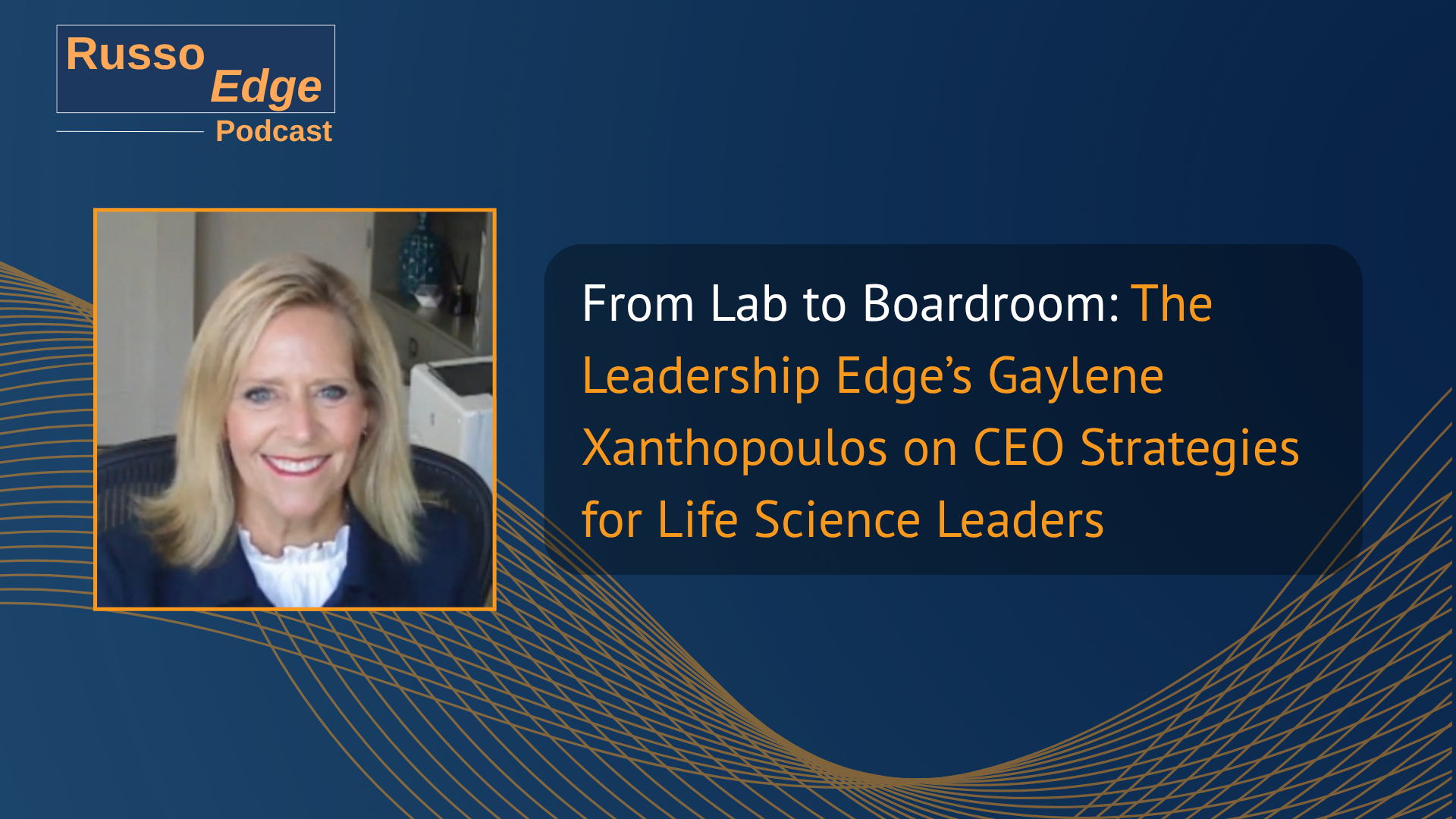
Gaylene Xanthopoulos, CEO and founder of The Leadership Edge, joins the Russo Edge Podcast to share her expertise on leading life science companies through growth, innovation, and investor engagement.
As an advisor to biotech CEOs and board members, Gaylene delves into the unique challenges life science leaders face today, from building effective teams to establishing strategic clarity and fostering resilience. She also offers advice on preparing for high-stakes events like the JPMorgan Healthcare Conference and the art of communicating effectively with investors.
Solomon Wilcots: Welcome to the Russo Edge Podcast. Today is one of those conversations, and we’re going to have it with our really good friend, Gaylene Xanthopoulos, CEO and founder of The Leadership Edge.
She joins us from La Jolla, California. Gaylene has been counseling life science leaders for more than thirty-five years. She’s mastered the art of guiding executives and board members through high-pressure, fast-moving environments, all the while finding the winning way to communicate with investors. She’s passionate about the intersection of science, business, communication, and overall success. For executives looking to strengthen their approach, Gaylene’s wisdom is invaluable. Welcome, Gaylene. How are you doing today?
Gaylene Xanthopoulos: I’m doing great, Solomon. Thanks so much for having me.
Helping Life Science Leaders Show Up at Their Best Every Day
Solomon Wilcots: Well, of course, it’s great to have you join us today. We want to talk to you about The Leadership Edge. Let’s start there. Tell us what it’s all about.
Gaylene Xanthopoulos: Well, I guess what I’d start with is I believe I have the best job in the world, and I’m so fortunate, but it also seems like yours is pretty good too, Solomon. I don’t know. You better look out.
Solomon Wilcots: Well, yeah, we appreciate that. Go ahead. I’m sorry.
Gaylene Xanthopoulos: But every day I have the opportunity to help life science leaders, whether they’re in the boardroom or at the bench. It’s leaders, managers, and teams to show up every day as their best, and as a result, increase performance in these organizations so that they’re able to accelerate the pace at which we get great solutions to patients. That’s what we’re all about at the end of the day.
From Scientist to CEO: Shifting the Mindset From Lab to Company
Solomon Wilcots: Now, what are the common challenges or needs of a first-time CEO, and how must the CEO adapt as the company evolves over time?
Gaylene Xanthopoulos: It’s a great question because the needs of a CEO evolve over time, both in terms of their own experience but also in terms of the stage of a company’s development. If you think about an early-stage or first-time CEO, one of the first things when I’m coaching a CEO is to talk a little bit about—you’re not building a lab; you’re building a company. That’s a big shift in mindset, especially for a scientific founder. What that means is they have to start first by building a foundation for success. That means establishing their vision, their mission, their values, because this sets the foundation, as I said earlier, for everything that follows. Then beyond that, we go into strategy.
This is another area where I see a lot of first-time CEOs not valuing strategy. They have a very operational mindset and a short-term mindset. That’s understandable because they’re focused on science and just trying to move that science forward and show proof of concept with the science. But they have to have this longer-term strategy, and I think as we talk a little bit more about how financing happens, that’s critical to the equation.
The next piece is about messaging. Do they have a story to tell? The strategy, the vision, the mission provides that context for the story that they share, whether they’re recruiting great talent or they’re going out for some investment. Those are some of the things that happen early on, and then it starts to evolve and change over time.
Why Clear Communication Starts Inside the Organization
Solomon Wilcots: Now, I know you often talk about and mention how important communication is, internal communication as well as external communication. Why is that?
Gaylene Xanthopoulos: Well, I think if starting with internal communication, if we’re not aligned as an organization, it’s a mess and that starts with the leadership. When you have that great foundation in place of a clear strategy, clear goals, and a clear sense of purpose, it aligns the entire team in the organization. If we have alignment and clarity, we can be much more efficient.
In an industry where money is extremely tight and difficult to access, especially today, and yet you’re burning a tremendous amount of money, it’s critical that we have those efficiencies. We can’t have people doing things that aren’t on the critical path or aren’t taking us where we ultimately need to go. So that internal communication is key. If we have that, then it positions us beautifully for external communication.
When we show up to the external world, people sense that strong alignment in the organization, the efficiencies that follow, and it helps us more clearly articulate that purpose, mission, goals, values, and sell a story that is not only compelling but also believable. People feel that you can actually execute against the things that you’re putting out there to investors and stakeholders.
Why Investors Bet on People and Teams, Not Just Assets
Solomon Wilcots: Well, many of the clients that we work with today are public companies. What should CEOs be thinking about when communicating with investors, and why is that important?
Gaylene Xanthopoulos: Well, your investors are critical, obviously. This is, again, an industry that burns so much money where you’re measuring burn rate, not profitability, sometimes for up to twenty years. There’s not another industry quite like this. When you’re going out to the investment community, we’re still dealing with people. At the end of the day, they want to deal with people that they like.
We always talk to CEOs about showing up as your authentic self. If you’ve got a sense of humor, use that. If you can show some vulnerability, that’s great. If you can be a good listener because, you know, bankers, analysts, VCs want to know that they’re listened to and they’re heard. It’s not only what you say, but also how well you listen that is key. When we’re out there as a public company, at the end of the day, they’re buying you and your team. Showing up in a way that shows that the team is aligned and that you as a leader have empowered other people, you brought in great talent, and you’re letting them do the job is really important.
Lastly, its credibility. You just have to be able to make commitments to investors that you feel confident you can execute against. Because if you’re credible and you’re hitting those milestones, the investors show up for the next round of financing or the next company that you start.
Sharing the Stage to Build Confidence in Organizational Depth
Solomon Wilcots: You just advised, look, show up as a team, as an organization. You know, CEOs, they just have that mindset. They want to get out there; they want to lead. So how do you kind of thread the needle? How do you teach maybe the nuance of being that strong leader, but still working together as a team?
Gaylene Xanthopoulos: Well, I think part of it is really understanding. Initially they come out and think, “I’m the CEO. I have all the information. I’m the leader. I need to be at the helm,” so to speak and that’s true. We typically have our CEO showing up—let’s say it’s on a quarterly earnings call. You’re going first. You’re setting the stage. You’re talking top line, and you’re also talking strategy. Then you want to be bringing in your CFO to be talking about finances, not you. You want to bring your CMO to be talking about the clinical development and how you’re doing with that. You want to bring in your CSO to talk about your early-stage work. And the reason we do that—I think there’s a great example.
I remember a very prominent leader in this industry, and talking to him, he became a VC, and he and his partner had just had a pitch. Somebody had come in and pitched for investment. When they both walked out, they looked at each other and said, “No way in heck are we investing.” I asked him, “Well, why? What led to that outcome?” And he said, “Every time the CEO talked, the entire team looked—or every time we asked a question, the entire team looked to the CEO for the answer. What we saw was we’re not just betting on the CEO; this is not a team.” That’s so critical.
You have to realize investors are betting on the team. I’ve had a hedge fund hire me before to say, “Hey, Gaylene, how can you help me evaluate and assess a team without going under NDA?” Because the hedge fund wants the freedom to trade, right? They don’t want to be under NDA. He says, “I want to be able to understand if they’re any good because I can look at the science and understand that. I can read the financials and understand that, but I’m betting on the team because good science with a great team will succeed. Great science with a mediocre team will fail.” We’ve got to always remember it is about the team and that consistent messaging that comes from the team.
Raising Capital in a Risk-Averse Post-Pandemic Market
Solomon Wilcots: That’s very interesting and great information because you mentioned helping CEOs as their companies create value. What does it take to raise capital in today’s market? It seems to be getting harder, you just gave a great scenario, how people would laugh saying, “Oh, we’re not going to invest.” Maybe they didn’t see the team that they wanted to be a part of. So how can you make it easier for maybe some of your clients to be able to raise capital in today’s market?
Gaylene Xanthopoulos: Today, we’re coming out of a couple of years out of the pandemic, but we’re seeing this huge shift. During the pandemic, when there was a tremendous amount of capital to be deployed, but no place to invest it, people turned to life sciences and said, “Wow, this is the place I need to be putting my money in.” What we saw was a lot of first-time CEOs becoming public leaders of public companies very quickly. We saw a lot of companies that weren’t ready to be public either because their CEO is not skilled, their management team wasn’t ready, and in many cases, the science wasn’t ready. You saw tons of money; it was raining money. A lot of these first-time CEOs also thought this is how it goes—you have a great idea; people throw money at you. As a result, we saw a lot of companies fail. We saw some mismanagement of the capital. Investors got hurt. They haven’t had a good exit because the markets after the pandemic closed on the life sciences.
A huge number of publicly traded life science companies today have less than a year’s runway, which is risky. Investors now, I think your advantage today depends on your therapeutic area. Obviously, if you’re a GLP-1 company, six months ago, a year ago, people were excited. That’s the Ozempic types of products and things. That’s a huge market. A lot of money went into those companies. You have other hot therapeutic areas as well. But if you’re not in one of those spaces that seems to be attracting some capital then investors are very selective about where they’re putting their money because they can’t afford a loss at this point.
You have to have the things I talked about; you have to have a clear purpose, passion, all that. The strategy has to be clear; your plan has to be solid. You have to show that you can deliver on milestones. You’ve got to be pretty close to data. Either good data has come out or it’s in the very near future because they want to reduce the risk. Anything to reduce risk is what investors are interested in.
They will also always bet on a successful track record. You’ve got leaders who’ve made them money in the past, they’ll typically line up and show up again. It so often comes back to basics and being somebody that you want to bet on and you’re willing to take the risk to bet on.
Using the Board as a Strategic Resource, Not a Constraint
Solomon Wilcots: Yeah, they often want a short runway. There’s no doubt about it. How can CEOs manage their executive boards better to meet the growing expectations?
Gaylene Xanthopoulos: Number one, make sure you have the right board. We sometimes see that you have the wrong people on the board. You might have a board full of only investors, and that’s difficult because there’s sort of conflicts at times in terms of what’s driving their motivation. But I think that if you have a good board and you have an experienced board and you have one or two independents on your board, that helps because they’re coming to the table with more realistic expectations. They’ve been around the block a few times. They understand the markets and what’s happening. They’re thinking about longer term, bigger picture types of investment and return to shareholders as opposed to an immediate flip or something that can happen very quickly. I think they just are more practical and realistic about what’s expected.
The other thing is that CEOs need to run close. It’s not about managing your board it’s about collaborating with your board. They are there as a great resource to you and sometimes they do need to help you course correct or they do need to help you accelerate or raise the expectations, and that’s appropriate. Running closely with that board, understanding what motivates them, understanding how they take in information. If we’re coming in with tons of detail, and the board are people who like to think strategically and if you haven’t given them that strategic context, they’re unlikely to move forward and support the ideas that you’re putting in front of them. You have to know each individual board member, the roles they play, how they think, how they make decisions. Hopefully you’re dealing with an experienced board.
Turning J.P. Morgan Into a Strategic Meeting Opportunity
Solomon Wilcots: Gaylene, how should a new CEO approach a milestone event like, say, the J.P. Morgan conference, which can serve as a tremendous launch point?
Gaylene Xanthopoulos: I’d say number one, rest up before you go.
It’s definitely a sprint and wear comfortable shoes. Because they’re on the run for those few days that they’re there. Bottom line is it’s a lot about preparation. Working with organizations like Russo to make sure you’re clear on your messaging. You’ve got a good reputation and image. You’re able to line up a lot of meetings because, as much as that conference is a conference, it is a common meeting place. That’s what it’s become over the years. Getting those meetings lined up is important but also understanding what your objective for each of those meetings is.
Being very well prepared, anticipating what the person you’re meeting with is going to be looking for so that you’re ready and can respond, but also have your thirty-second commercial down. Thirty seconds or less. The people you’re passing in the hall or the ones you’re introduced to—you can put a compelling enough reason out there that they want to schedule a meeting with you after the conference is over. Being prepped, having your deck, knowing what you’re there for, going with a sense of purpose.
And then, like I said, resting up. I have clients who are at three events at night, moving from one dinner to the next to the next. They’re very full by the end of the conference because that’s all they’ve done is eat and move. But preparation is everything for that.
Communicating Purpose Beyond the Science
Solomon Wilcots: Well, you’ve given us such great information. I have to ask, any last final words of wisdom for good communication and how important it is for leaders in life science in that particular industry?
Gaylene Xanthopoulos: Be clear on what you’re hoping to accomplish as a company. People get excited about the science, but it’s to what end. We’re not research scientists anymore. You’re working to get a product out there that will enhance patients’ lives. You have to understand your audience. If I’m talking to an investor, they care about my returns. It’s when will I see a return and how confident am I that you can deliver on that? Being able to have a very clear plan that you feel confident you can achieve, clear financials so that people can see it and don’t bring in a two-hundred-slide deck. That is such a mistake. Being able to build that story and engage them in that process so they don’t want to miss on this. Remember, investors, they are a pack mentality. If I’m the only one out there getting excited, I start going, what am I missing? If I can get a good consortium coming together that’s excited about what I’m doing, it’s important, it’s everything.
Be authentic. Communicate when there’s uncertainty. Over-communicate, even if it’s, “We should have an answer in the next couple of months.” People want to be brought along in the absence of information. They’ll make up negative information. They’ll assume the worst. I’ve never seen an organization that over-communicates.
Solomon Wilcots: You have to develop your own narrative, and you have to be very good at just continuing to bang that drum and be very consistent while doing so. Thank you to all of our guests and our good friend, Gaylene Xanthopoulos, CEO and founder of The Leadership Edge, for joining us on the Russo Podcast. Of course this is Solomon Wilcots. Thank you for joining us, everyone.
The Russo Edge Podcast is hosted by Solomon Wilcots and features candid conversations at the intersection of biotech, healthcare, and innovation, spotlighting leaders, scientists, and investors moving medicine forward. The following transcript has been edited for clarity.