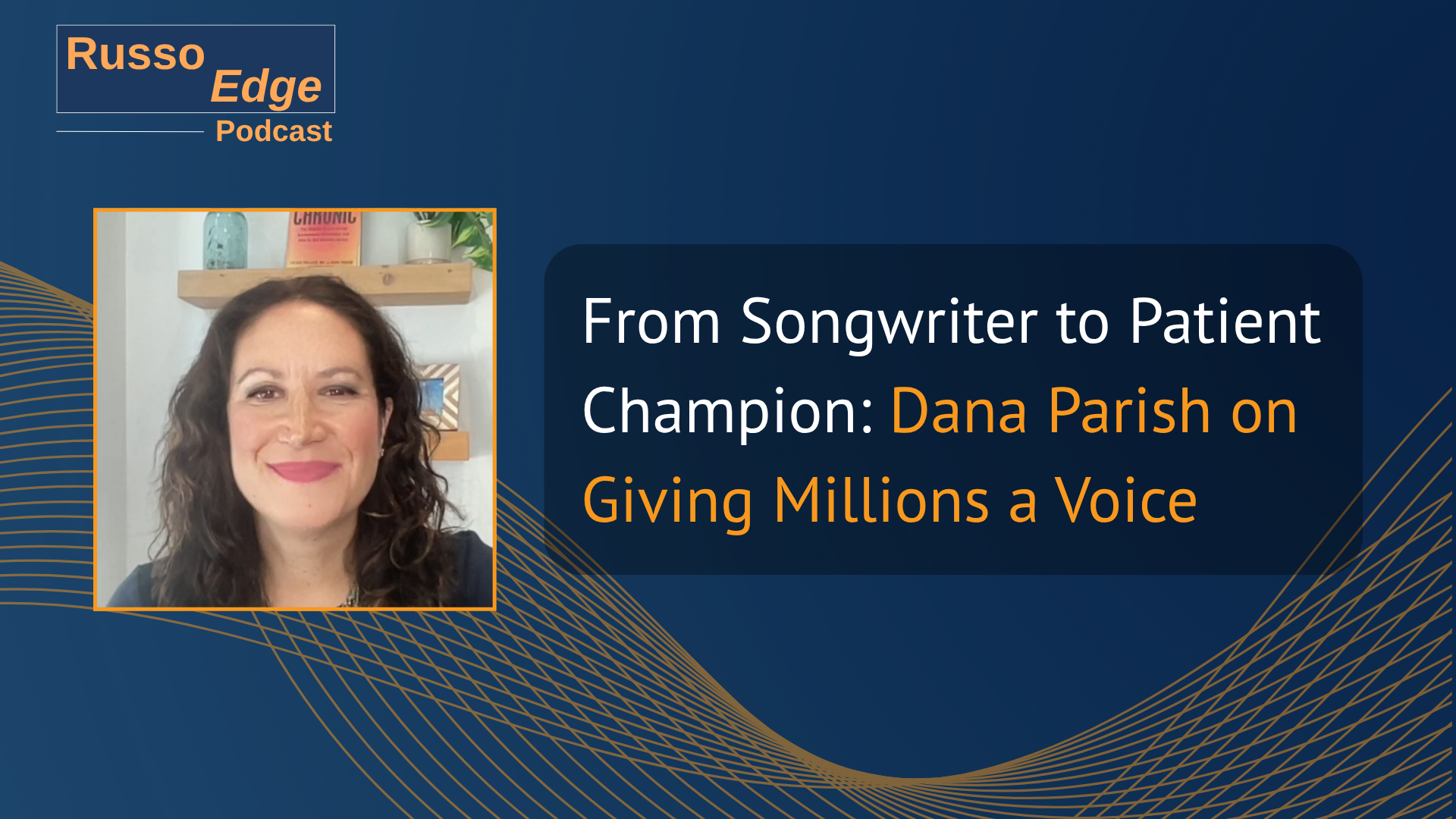
What happens when a chart-topping songwriter is brought to her knees by a mysterious illness, and a healthcare system that refuses to believe her nearly costs her everything?
In this episode of The Russo Edge Podcast, Dana Parish joins host Solomon Wilcots to share how her fight to survive became a mission to help others. Alongside Dr. Steven Phillips, she co-authored the bestselling book Chronic: The Hidden Cause of the Autoimmune Pandemic and How to Get Healthy Again and has become one of the most influential voices for patients with Lyme disease, long COVID, and other complex chronic conditions.
Whether you’re a caregiver, a chronically ill patient, or someone searching for answers, this episode offers validation, clarity, and hope.
Solomon Wilcots: Welcome to the Russo Edge Podcast, everyone. I’m your host, Solomon Wilcots, and today we’re speaking with Dana Parrish. Dana is an award-winning singer-songwriter, and she’s collaborated with legends like Celine Dion and Michael Jackson and more. But in 2014, a tick bite at a wedding nearly derailed her life. After top doctors failed to diagnose the real cause of her spiraling illness, which included heart failure and other devastating symptoms, Dana finally found proper treatment with Dr. Stephen Phillips and recovered from multiple tick-borne infections. She then turned her ordeal into action, becoming a powerful voice for others who are facing chronic and autoimmune illnesses. Dana, welcome to the Russo Edge Podcast. It’s great to have you on today.
Dana Parish: Thank you, it’s so great to be here.
How a Single Bite Changed Everything
Solomon Wilcots: Well, let’s get started with your journey. You went from someone who was going to a wedding to enjoy yourself over the summer of 2014. And then you got a tick bite and everything changed overnight. Can you tell us more about what happened at that wedding and how your illness really first unfolded?
Dana Parish: Sure. It was the summer of 2014, July 4th weekend. I was at my friend’s wedding in New Jersey on Long Beach Island at the beach. We don’t think of a beach necessarily as a hot bed for Lyme and for tick-borne diseases. I think I was bitten either on the beach or in my sleep in the beach house that my friends rented because they allowed dogs and dogs carry ticks in all the time.
Anyway, so there I am singing at my friend’s wedding, making a speech. I go home two days later to my apartment in Manhattan, and I should mention I was on the verge of signing my dream deal with Sony Music Publishing at that moment. I had just scored two songs on the new Celine Dion record that was forthcoming at that time, and I was out of my mind with excitement and happiness and just looking forward to the road ahead working with all these superstar artists that were on my dream list for a long time.
There I am, I come back to Manhattan. I have this little itchy bite on my shoulder and a few days later I see what looks like a rash—not a typical bullseye that you see on the CDC website, but what I later found out is actually more common. It was just this little pink rash. I walked to the urgent care on a Saturday and they said, “You have Lyme. Take three weeks of doxycycline and you’re going to be fine—and don’t Google it.” And I thought, that is such a weird thing to say.
I felt so ill at that time. I had severe crushing neck pain and headache, feverish in the summer—it was so strange. Something felt very wrong. I took the three weeks of doxycycline, my initial flu-like illness calmed down, and I just remained fatigued. And then in October, all hell broke loose—whole body, multi-systemic illness. Months lagged between my bite and my real symptoms.
A Medical Mystery Despite Doing Everything Right
Solomon Wilcots: Well, it seems like you did everything right. You caught the Lyme early, took the antibiotics. So what happened next? How did things unravel despite early treatment?
Dana Parish: In October, I woke up one morning and my breast was swollen, and I had severe pain. I went to my internist, and she sent me to an oncologist because she was worried about breast cancer. The oncologist said it wasn’t cancer but agreed it was swollen, and he didn’t know why. That began my journey of seeing a dozen doctors. My next symptoms were severe body pain; they said it was fibromyalgia. I had severe anxiety, depression, insomnia—like my brain was taken over by monsters. I had no history of any of this. Prime of my life, happy, successful. Doctors tend to write you off when it’s complex—they say stress or “it’s in your head.”
I went to infectious disease, internal medicine, oncology, allergists because of the symptoms. Nobody put the pieces together. They were willing to medicate my symptoms, but nobody evaluated me for other tick-borne infections. I didn’t even know about them yet.
Solomon Wilcots: Eventually you did find answers when you met Dr. Steven Phillips, who later co-authored your book. Tell us what meeting him meant to you.
Dana Parish: Around Christmas 2014, I was deteriorating so fast that I flew to my friend’s farm in California to rest. I became short of breath, googled all my symptoms, and found a Lyme checklist by Dr. Joe Boroscano. I had 38 or 39 of the 60 symptoms. I kept saying, “I think this could still be Lyme,” and everyone said it was impossible because I took antibiotics.
I put out word that I needed a Lyme specialist. Someone had seen Dr. Phillips testify before Congress about Lyme laws. I went to him, he listened, he believed me, and he immediately knew I was undertreated and likely had another infection—Bartonella, also known as cat scratch disease, commonly spread by ticks.
Turning Survival Into a Platform for Awareness
Solomon Wilcots: Once you recovered, you became a patient champion. What led you into that role? What more can you tell us about that? And the way you can speak up for others?
Dana Parish: That shortness of breath was actually heart failure. Once that happened, my anger and fear skyrocketed. I was close to death. Someone asked me to write my story for the Huffington Post. I thought maybe 25 or 50 people might be helped. But it went viral. An editor asked me to write more.
I interviewed Christopher Sands about his long-undetected Lyme leading to dementia. I interviewed Daryl Hall, who had severe Lyme. His doctor, Richard Horowitz. I created about seven or eight pieces—my “album,” as I call it. I was also doing press with my doctor because many specials about Lyme were being made. We were even featured on Fox’s Lyme and Reason, which won an Emmy.
We ended up with a bidding war for our book and wrote Chronic: The Hidden Cause of the Autoimmune Pandemic and How to Get Healthy Again. It’s about stealth pathogens—Lyme, Bartonella, others, including COVID—and how they are linked to chronic, autoimmune, neurological, and psychiatric diseases through a huge body of literature most doctors don’t know.
Asking What’s Causing Disease, Not Just Naming It
Solomon Wilcots: And what message were you hoping to send with the book?
Dana Parish: That everything has a cause. Even conditions labeled “idiopathic,” like autoimmune disease or cancer—meaning “we don’t know.” But often infections are at the root. There are environmental factors and genetics, but it’s rarely driven purely by genetics.
Autoimmune disease is often the body’s inflammatory response to something like infection. Your body is trying to protect you. But you need to help it by finding the root cause. When I got proper treatment, I got completely better—no long-term drugs. I’m very lucky.
Solomon Wilcots: What advice would you give to someone feeling unheard by their doctor?
Dana Parish: Be hyper-organized. Write down your most important questions and symptoms. If you can, bring someone with you—they can take notes, listen, advocate, and support you because being sick can overwhelm your thinking. Be respectful but direct. Say what you need and ask, “What could be going on?”
Empowering Patients to Ask Better Medical Questions
Solomon Wilcots: What is one actionable step someone can take today if they’re unsure where to turn?
Dana Parish: This is the first time I’ve ever said this, but AI has become surprisingly good at identifying diagnoses doctors sometimes miss, especially complex tick-borne diseases. That’s one option.
Another is doing your own research. It’s controversial, but if I didn’t, I don’t think I’d be alive. Use PubMed or Google Scholar—type in symptoms and see what patterns emerge. For me, everything pointed back to Lyme.
Solomon Wilcots: Many people fear “being their own doctor.” But you need to know enough to ask the right questions. For those with loved ones who have chronic illness—Lyme, long COVID—what advice do you have for caregivers?
Dana Parish: Believe them. Trust them. Support them by listening. Send a text: “How are you today?” Tell them you love them. Don’t ask for big commitments. When I was very sick, I couldn’t plan lunch for Wednesday—I didn’t know how I’d feel. Give them grace. Let them check in when they can. If you can hold space—”If you’re up for it, I’m here”—that means so much. Drop by with a loaf of bread. Just be a good friend and believe them.
Solomon Wilcots: Great advice. Tell us more about the book Chronic. Where can people find it, and what else are you working on?
Dana Parish: You can get Chronic anywhere you buy books—Amazon, Barnes & Noble, anywhere. I’m working on a podcast, The Dana Parish Podcast. I’ve gotten to interview the former CDC director Robert Redfield—that was my first episode, and it made headlines. I’ve interviewed Dr. Steven Hatfield, a virologist and former head of pandemic response under the Trump administration. I get to talk to top scientists, and I can’t believe they keep saying yes. I have so many questions.
Solomon Wilcots: You are the absolute best. A heartfelt thank you to Dana Parish for joining us today. Her journey—from chart-topping music to battling a mysterious illness to becoming a fearless patient champion—exemplifies resilience and purpose. Dana’s story proves that healing is possible and your voice matters. I’m Solomon Wilcots and this is the Russo Edge Podcast. Thank you for joining us.
The Russo Edge Podcast is hosted by Solomon Wilcots and features candid conversations at the intersection of biotech, healthcare, and innovation, spotlighting leaders, scientists, and investors moving medicine forward. The following transcript has been edited for clarity.