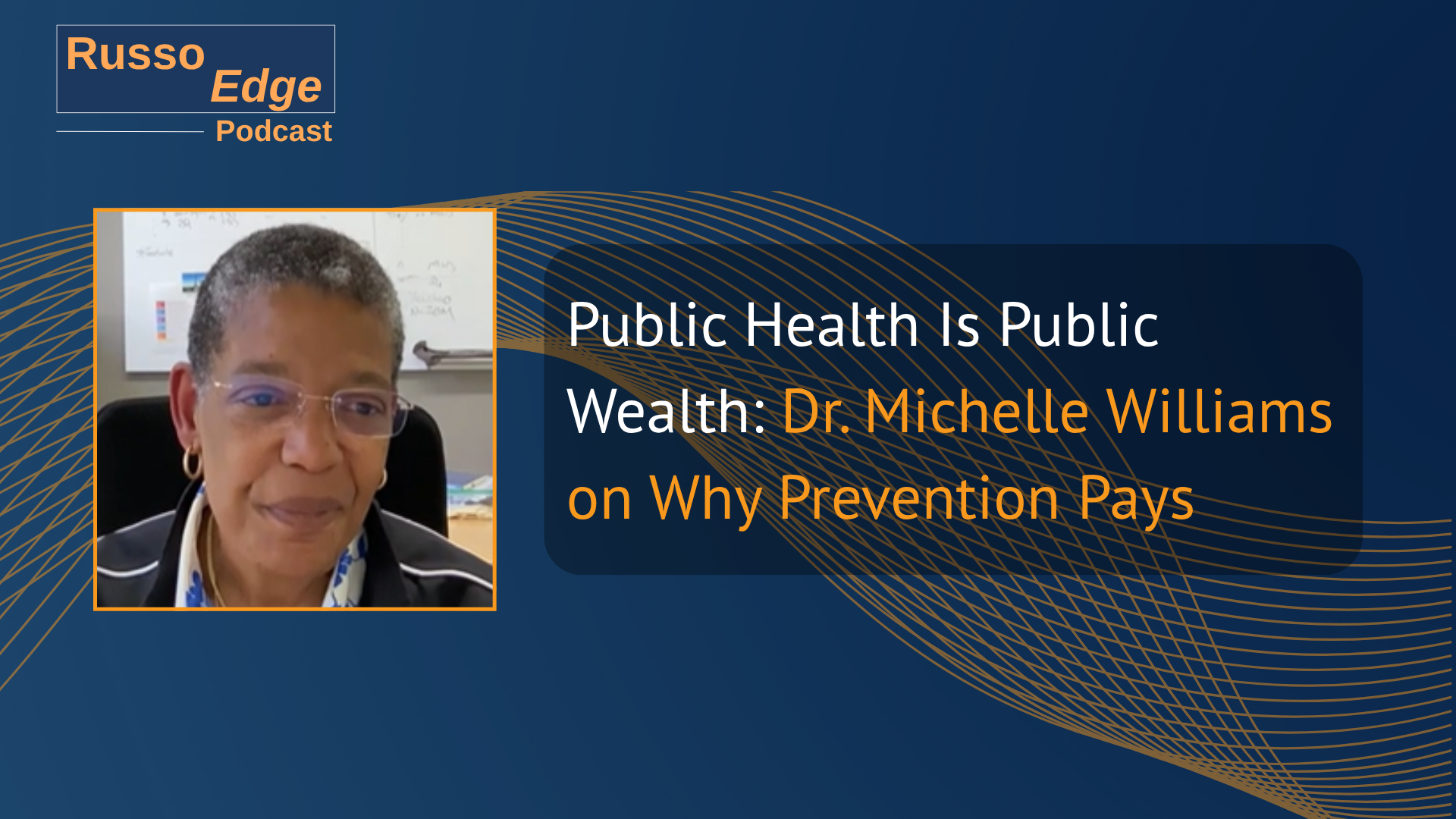
What if we treated public health the way elite athletes and teams treat performance? Something to build, protect, and invest in. Today’s guest, Dr. Michelle Williams, reminds us that the systems that let people live longer, work safely, and raise their families, along with pursuing their ambitions, did not happen by accident. They were built over time, and right now many of those protections are under pressure.
Solomon Wilcots: Today we’re looking at public health, not as a charity and not as an abstract policy debate, but as the infrastructure that makes human performance possible. Joining us is Dr. Michelle Williams, Professor of Epidemiology and Population Health and Associate Chair for Academic Affairs at Stanford University School of Medicine. She is the former Dean of the Harvard Chan School of Public Health and has published over 540 peer-reviewed scientific articles and was elected to the National Academy of Medicine in 2016.
In 2020, she received the Ellis Island Medal of Honor and was recognized by PRWeek as one of the top 50 health influencers of the year. She is also the author of the new book, The Cure for Everything: The Epic Struggle for Public Health and a Radical Vision for Human Thriving.
Michelle, welcome to the Russo Edge. Great to have you on the show. You’ve been busy, haven’t you?
Dr. Michelle Williams: I always stay busy. Thank you, Solomon. It really is an honor to meet you and to be on your show.
Solomon Wilcots: We’re honored to have you. There’s no doubt about it. Let’s get started with talking about your book. This is a phenomenal piece of work. It’s called The Cure for Everything. Now, that’s an intentional big claim, I’m sure. That’s what you wanted to do. You wanted to grab our attention. What does it all mean, Michelle?
Dr. Michelle Williams: Yes, you’re right, Solomon. I wanted this to be an audacious title. I wanted it to grab people so that they understand the message that I’m trying to get across. And the message is public health, which looks at populations writ large, aims to create the environment for everyone to thrive. Public health is not a pill. Public health is not medicine. Public health is actually even more proactive than medicine in that we care about the places and spaces where humans occupy, and we want those places and spaces to allow everyone to thrive.
Solomon Wilcots: I think that brings great clarity in terms of what we’re here to discuss today. And you spent much of your career writing for academic audiences. Why was it important for you to write this book now for a broader public audience?
Dr. Michelle Williams: I felt there was an urgent need for people to understand what we in academic public health know, and that is public health is responsible for the doubling in human life expectancy over the last century. Public health is responsible for the 90% reduction in infant mortality.
Public health is responsible for our waking up in the morning, driving to work, wearing that seatbelt, and knowing that we’ve got roads and highways that are designed intentionally to reduce traffic accidents. I want people to really understand that public health is most successful when we don’t notice it. I felt there was an important need for people to understand public health because if you don’t understand it, you don’t value it. And people really have to understand that public health brings wins and benefits to us all that we have to fight for and preserve.
Why Public Health Is Infrastructure, Not Charity
Solomon Wilcots: Great explanation, and you say that public health is not a charity, but an engine that drives everything. And I know you just gave us some examples of that. What more should people know, and what do you think they misunderstand the most about what public health actually is?
Dr. Michelle Williams: That’s such an important question. I think when people think about public health, they’re looking at failures. They’re looking at the Superdome crowded with people abandoned because of Hurricane Katrina. When people think about public health they think about what March 2020 looked like when the whole world came to a full stop because of COVID.
Now, those are failures built into a system where public health was not invested in and supported in the way that allowed for us to have the resilience against threats to our health and to society. When people think about public health, I want them to recognize that public health is the engine that keeps society humming. Public health is what allowed the city of New York to grow into this dense, beautiful metropolis. Without public health, without clean water, without parks like Central Park, the lungs of New York City, that would not have been possible.
That’s an example of a public health investment. The water system in New York City that allows 15 million people to live on that small island. And to have clean and safe water, I want them to know that New York City and Philly and LA are cities that thrive because a hundred years ago, people, leaders invested in public health. And when public health works, everybody thrives, and you get a humming economic and booming opportunity.
From the Locker Room to the Boardroom: Health as an Asset
Solomon Wilcots: It’s an amazing example of how we’re all able to live in such close proximity together and still remain healthy. Other than that, we would have to spread out. We wouldn’t be able to be as close to one another. Public health works in so many wonderful ways that makes our lives better.
I am a former NFL player, Michelle, and I know for a fact that the NFL lends great support for its players. They give us the best trainers. We have the best nutritionists. Sleep specialists and mental health staff, they spare no expense to help keep us healthy because we have to service an industry. We have to be healthy in order for the business to be viable. Why don’t we apply that same logic to the broader population?
Dr. Michelle Williams: I love that example, Solomon, because what the NFL recognized is that health is an asset and that the players remaining healthy requires an investment. You talk about the nutritionist, you talk about strength coach, and you talk about the psychology coach who helps with stress and sleep.
Think about how much healthier and better our society would be if we invested like that to promote excellence, to promote optimal performance of our children in schools by providing great school lunches, by providing communities with community health workers who are looking out to make sure that we are keeping the population healthy by having systems in place to support health and wellness. Think about public health being exactly what you described: proactive, evidence-based interventions designed to allow us all to perform at our optimal capacity. In the ideal world, public health would be doing exactly what NFL does to take care of its asset: humans and human health.
Solomon Wilcots: I think it proves that when there’s a priority there, we can make it happen. Now I know you were leading the Harvard Chan School of Public Health during the pandemic. You were leading those initiatives when business leaders were asking how to reopen safely, how to get back to work, and how to bring customers back into their shops and get businesses going again. What did that moment really reveal about how central public health is to economic life?
Dr. Michelle Williams: That’s another great question and I want to say this. It was my aha moment. It was my Oprah Winfrey moment because I never in my career thought I’d have CEOs of Fortune 500 companies knowing my name, let alone calling me and asking me for advice. But as the dean of one of the best schools of public health in the world and during a pandemic, everybody was focused on public health, whether they wanted to or not.
For me, it was a moment that I needed to turn into a movement. I needed to grab this moment and create an opportunity for people to understand public health as being more than a charity. And I wanted people to understand that those of us in public health, we resonate with the moral imperative of health as a human right. But the rest of society, the bankers, the CEOs, don’t think about public health the way we do, so I wanted them to think about public health as an economic imperative. I created this little webinar in the middle of the pandemic called When Public Health Means Business. There I go again with provocative titles.
But I wanted this to happen because I wanted to bring the moral imperative and the economic imperative together. And I wanted strange bedfellows, bankers, CEOs, public health advocates, community workers, and journalists to come together. We didn’t have much to do during the pandemic. We were all sitting at home. I said, let’s get together and let’s talk about what public health looks like from the CEO’s vantage point, from the employee’s vantage point, and from the banker’s vantage point. And I think that was really an opportunity for me.
Never did I imagine that I’d be programming when public health means business. But for me, it was an opportunity to get people to think about public health in a more expansive way.
The Hidden History Behind Public Health Wins
Solomon Wilcots: Incredible. It was a moment of clarity, and you said it. You turned the moment into a movement. Now, some of public health’s biggest successes are now so very familiar to us that we barely notice them, like clean air, safer water, safer workspaces. Who really fought for these advances, and why is it so easy now, Michelle, to take some of those advances for granted?
Dr. Michelle Williams: When good things happen in public health, nothing happens, right? When public health is most successful, it’s not visible. That’s the paradox that we have. And it’s why having an opportunity to talk with you and your audience about public health is so precious to me. When I think about, again, my beloved New York City, where I grew up. Back in the 1830s and 1850s, as the city started to get more densely populated, everything had to stop because cholera in the water was killing people. One of my public health heroes that I talk about in the book is John Snow. He’s this nerdy guy, he’s a vegan, but he loves data, and I know, Solomon, you love data.
Solomon Wilcots: Yes.
Dr. Michelle Williams: And John Snow, when nobody cared about the data he had, documented that you could prevent people from dying in the 1800s from cholera if you were mindful of the source of the water. If you were having filthy water, you were going to be at high risk of dying. People don’t remember John Snow. The funny thing about John Snow is that it took an act of civil disobedience. Because people didn’t listen to him, he took the handle off the pump where the dirty water was being accessed.
Solomon Wilcots: That’s right.
Dr. Michelle Williams: People don’t remember that W.E.B. Du Bois, when he did the Philadelphia study in the Seventh Ward, created a movement and a science that was social epidemiology, where he showed it was the environment that accounted for Black people dying prematurely, not something innate in them, but the social determinants. W.E.B. Du Bois was onto something a hundred years before we even knew what to call it. He was onto the fact that it was the environment, not our human biology, that made for health disparities between Black and white people in this country.
Solomon Wilcots: He helped expand in a more proactive way of things that we could do to keep our environment safe and help keep human beings safe. I know in the book, you talk about the Missing Americans. What does that phrase mean? And why is it such a powerful way to understand the cost of public policy failure?
Dr. Michelle Williams: Yes. Missing Americans, another provocative title, is the product of work by Jacob Bor, who is a professor at Boston University. And what Jacob and his colleagues showed was that when you compared the death rates of Americans, all Americans, to the death rate of people living in equally wealthy countries, like Canada, France, and Japan,
In the year 2021 alone, 1.1 million more Americans died than individuals living in other wealthy countries. Here’s the shocker of what he and his colleagues showed. Of those 1.1 million deaths, about half occurred before age 65, and white Americans accounted for about 70 percent of excess deaths in 2021.
That number is important because it underscores that all of us are at risk, not just Native Americans, not just African Americans, but all Americans pay the price for living in an ecosystem where public health, health promotion, and disease prevention are under-invested in. I think we should take a lesson from that. And the lesson is public health matters to all of us. It’s not something that is politically divisive. It is not something that benefits only those people. Public health, when it works, allows every single one of us to thrive.
The Human Stories Behind the Numbers
Solomon Wilcots: Incredible. Absolutely incredible. It shows that, even with all the knowledge we have, if we start to refute that knowledge, we can move backward in the science of public health. We need to remain vigilant and continue to educate ourselves and continue to believe and trust in the data. And Michelle, you made the point that data alone does not move people. So why does public health need both evidence and the human story?
Dr. Michelle Williams: Another brilliant question. I know you’re a data person, and data is beautiful, right? Data, when rigorously collected, thoughtfully and transparently analyzed, and then thoughtfully interpreted, is important. It’s the basis, the foundation of science. But data alone does not change hearts and minds, right?
We need stories and what I have discovered in my own career and trajectory is that sometimes we get so wrapped up in the data and the techniques and the way we show the data that we forget that we need to add the human face to the numbers. We need to tell the story.
Stories matter because that’s when you really get policymakers, for example, to understand how they can move the needle on population health. Yesterday, I was giving a lecture at North Dakota State University. I could have just talked about the fact that American women are three times more likely to die during childbirth than women in other wealthy countries. Or that Black women are 3 to 4 times more likely to die than their white counterparts here in America.
But without going to the numbers, I started to tell the story of Shanice Wallace, an African American doctor who at the prime of her life, everything was working out for her and her husband, and she suffered a preventable loss of life during delivery. She had hypertension in pregnancy, and it could have been detected earlier and managed properly. It wasn’t, and she died prematurely. Now, when you put the numbers and the human face onto it, I believe the audience gets the full weight of the problem. And with that full weight, I would hope that they would be moved to advocate for public health and advocate for their own health and wellness.
Solomon Wilcots: Oh, you’re right. I think that human story is the connective tissue that sort of moves us and drives us to action, right? And we call it a call to action. When you hear those stories, they compel us to do something about it. It hits home. It’s our family members; it’s our loved ones that we care about as well. Now I know you work at the intersection of digital epidemiology, women’s health, and artificial intelligence. If these tools are used well, Michelle, what could the future of public health look like? And if they are not, what worries you the most?
Dr. Michelle Williams: That’s a question that has the upside and the downside. I’ll talk about the upside first. For those of us who love data and like to think about complex systems, today, with the use of AI and all the computational power available, public health people might have the best tools they’ve ever had at their disposal. But it’s just a tool. These computational tools and AI, they’re just tools, because they won’t be useful to us if we don’t have complete, good, unbiased data. I’m happy and excited about the opportunity.
But I’m cautiously optimistic about how this opportunity is leveraged because if we don’t appreciate that there are biases in the data already, we could actually make health disparities worse. If we don’t appreciate that not everybody is proportionally represented in the data, we could create more harm than good with these tools. I recognize the upside and the downside. I love the way you asked that question because I think what it does, it allows us to approach these tools with equity at the center of everything we do. And if we do that, and if we approach the data with humility and understanding,
I think we will be able, in public health in particular, to leverage AI in ways that will inform decisions that will integrate evidence and allow all of us to make better decisions and choices about where to invest, how to invest and where to find hot spots where we can really help people who are on the margins of wellness and thriving.
Solomon Wilcots: I know you said that when public health works, it allows people to soar. As we look ahead, what does a serious commitment to public health actually look like, Michelle?
Dr. Michelle Williams: When I think about your question, there’s something I want to share. It’s a quote that I love. Arthur Ashe, the great tennis player, is known for saying, “Do what you can, use what you have, start where you are.” And I like that quote. It’s an important quote to me because it tells us that every single one of us can do something. We can use what we have. The politician can use their platform to advocate for policies that can improve health for all. Supporting clean air and clean water is an example. The Clean Air Act is a perfect example.
Solomon Wilcots: That’s right.
Dr. Michelle Williams: Of how political leaders can bring about an investment that returns benefits in health and economics. If you are a parent, advocate, be in the schools and advocate for better school lunch. Advocate for physical activities in schools. Advocate supporting school nurses and mental health. If you are a lawyer, team up with folks in the community and advocate for environmental justice. And if you’re an academic like me, get out into the community and witness what public health is. Speak the language and listen to what people need and want. If we all do that, we soar, because it means we build a more resilient, wholesome environment where everyone can thrive.
Solomon Wilcots: That’s phenomenal. I was going to ask you, if we wanted to help, where can we start? You named so many different areas and spaces where we all can be proactive and contribute to creating a safer environment and lending to the growth of public health. I’ll wrap it up by asking this final question. Where do you still see reason for optimism? What leads you to believe that in public health, we have every reason to be optimistic as we move forward?
Dr. Michelle Williams: I hope everyone reads the book because I hope when people read the book, they will come away knowing that the reforms and the wins that we have had in public health in the last century came from renegades and radicals who overcame indifference, resistance and even hostility. I want the readers to understand that public health is strong. People committed to public health are committed to overcoming obstacles. And because we have that history and that commitment, it is a through line to today.
I also want to say I’ve spent my whole career in education. The young people coming into public health today are awesome. These are people with talents in engineering, in physics, in medicine, in biology, in theater, in communication, in health finance, and they’re coming with the purpose of wanting to create that environment that everyone can thrive. I’m cautiously optimistic. I know we have some headwinds, but we’ve got history behind us. I know the gains we have made in public health were hard-fought and won. We can do it, and I love the new generation of people coming in. They are smart, they’re clear-eyed about the challenges, and I think we have a good reason to be optimistic.
Solomon Wilcots: It’s nice to know young people are paying attention. They are watching. We want to give a big thank you to Dr. Michelle A. Williams for joining us and for reminding us that public health touches every aspect of our lives: how we live, how we work, and mainly how we all thrive, from prevention and policy to data, equity, and the systems we really rely on every single day. This conversation is a reminder that when public health works, people have a better chance to live the lives they want and reach their full potential. Michelle, we thank you for joining us.
The Russo Edge Podcast is hosted by Solomon Wilcots and features candid conversations at the intersection of biotech, healthcare, and innovation, spotlighting leaders, scientists, and investors moving medicine forward. The following transcript has been edited for clarity.