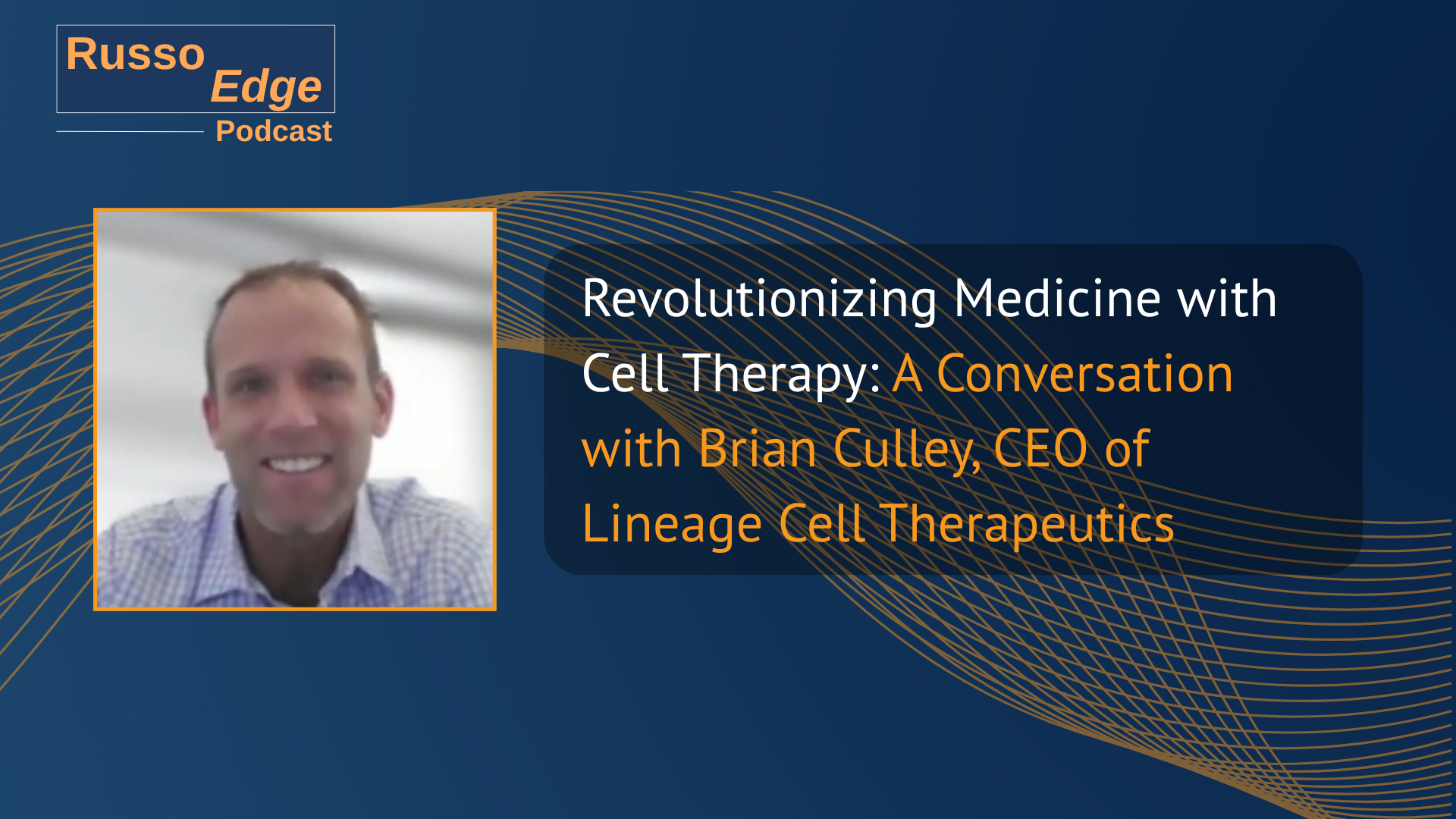
Can cell therapy provide a real solution for spinal cord injuries, as well as vision and hearing loss? In this episode, Solomon Wilcots speaks with Brian Culley, CEO of Lineage Cell Therapeutics, about how their groundbreaking work is creating new possibilities for patients.
Brian shares how replacing damaged cells with healthy ones is transforming the recovery process. Discover Lineage Cell Therapeutics’ latest advancements and how they could reshape the future of medicine.
Solomon Wilcots: Hello everyone, I’m Solomon Wilcots and welcome to the Russo Edge Podcast Show. And our guest today is Brian Culley, CEO at Lineage Cell Therapeutics in Carlsbad, California. Brian, how are you doing today? Welcome to the show.
Brian Culley: I’m doing great, Solomon. Thank you for the invitation. It’s a pleasure to be here with you.
How Lineage Is Advancing Cell-Based Therapeutic Innovation
Solomon Wilcots: Hey, what can you tell us about your company, Lineage, and how it uses a different cell transplant approach to replace cells that are absent or dysfunctional?
Brian Culley: Yeah, this is really an emerging branch of medicine. What we do is we manufacture what are essentially replacement parts, specifically replacement cells. And we transplant those cells into people to address specific conditions.
There are many diseases and conditions where you actually lose the cells that are performing the function that your body needs. A lot of these are associated with aging and degeneration. We manufacture brand new healthy cells of the same type and transplant them to the patient in order to try and get better quality of living and healthier outcomes for them.
Addressing Spinal Cord Injury With Targeted Cell Replacement
Solomon Wilcots: Now, I know you’re also doing some work with spinal cord injuries and trying to improve the outcomes. Why don’t you tell us more about how common these spinal cord injuries are, especially in a sport that I played in football, but yet there are very few approaches to creating positive outcomes. What are some of the things that Lineage has been working on?
Brian Culley: Spinal cord injury is one of the three areas that we get most attention for. We can manufacture specialized retina cells to help with one of the leading causes of vision loss. We can manufacture auditory neurons to help with one of the major causes of deafness. We also manufacture spinal cord cells, which helps people to recover their mobility and independence after an injury.
Specifically with the NFL, we see a lot of cervical injuries. Often these are linemen that maybe there’s bad technique one day and they end up with one of these traumatic injuries and they can be incredibly debilitating and paralyzing. What we do is we manufacture the same cell type that’s destroyed by the injury and place that into the area of injury a few weeks after the injury occurs. What we’re looking to do is provide that individual with some substrate some cells from which they can regrow and repair and hopefully that leads to better neurological wiring and recovery of mobility.
How Cell Transplants Complement Existing Recovery Modalities
Solomon Wilcots: Wow, that’s simply phenomenal. What other approaches can you maybe talk about when it comes to replacing cells that are different from rehabilitation or traditional medical approach?
Brian Culley: Yeah, what we’re doing is really different. I mean, we’re intervening just a few weeks after injury and really trying to drive healing. That’s very different than, for example, electrostimulation or physical therapy for rehab. But actually, it would probably work better with those, right? You’ve got some substrate in the spinal cord at the area of injury, and then you add on stim and PT, and maybe you can get much better outcomes than people would otherwise get if they didn’t have all of those modalities on board working together for best possible outcomes.
Expanding Cell Therapy Into Hearing and Vision Restoration
Solomon Wilcots: I’m also learning from reading some of your work that repeated trauma can lead to hearing loss. Many people don’t realize this. I know I didn’t realize it at all. Tell us more about how your work is progressing in this area.
Brian Culley: Yeah, the other two areas that we work on, hearing loss and vision loss, are massive because of the number of people who are affected. We have specialized cells in our inner ears called auditory neurons. And as you get older or you get exposed to really loud music, maybe when you were younger, you went to too many concerts, guilty, but you can lose those cells. We aim to replace those cells.
Actually, we’ve gotten a lot of attention because the same technology that we’re doing in the eye where we, of course, make a retinal cell, not an auditory neuron, but that has led to a very valuable partnership with a major pharmaceutical company called Roche. A lot of dollars flowed back to our company for partnering with them on that program. We’re seeing some really exciting clinical results with these programs. And we’re very excited about trying to improve health and well-being for people through this approach.
Lineage’s Vision for the Future of Regenerative Medicine
Solomon Wilcots: You seem to have some very innovative technologies that’s on the horizon. What more can you tell us about what the future holds for Lineage Cell Therapeutics and the possibilities that lie ahead?
Brian Culley: Well, we definitely want to build on the success that we’ve had and some of the lessons that we’ve learned in the lab and how best to do this. We have a few programs that we haven’t necessarily disclosed everything, but what I can say is that your body and my body, they’re made up of about two hundred different cell types. If you’re talking about islet cells for diabetes or you’re talking about dopaminergic neurons for Parkinson’s, there’s a very long list of diseases that maybe could be benefiting from replacing those individual cells with new healthy functional ones. We aim to be a leader in this space.
Solomon Wilcots: One last question before we let you go, because recently we heard NFL quarterback Brett Favre kind of talk about he had so many concussions and he’s been diagnosed with Parkinson’s. You talked about some of the work that you’re doing in that space. What more can you tell us about that?
Brian Culley: Well, there’s been a competing company that’s been focused on Parkinson’s, and I think it’s a really relevant area. We just don’t have very good therapeutics yet, and maybe either alone or in combination by replacing the cells that have died off in that disease, maybe we’ll see some therapeutic benefits that have been evasive to date. It’s a really exciting new frontier of medicine, and we’re glad to be a part of that.
Solomon Wilcots: Well, Brian, we want to thank you for joining us on the Russo Edge Podcast show. Doing a really great job as the CEO, again, of Lineage Cell Therapeutics in Carlsbad, California. We want to thank you for joining us on the show and sharing some of your insights on cell therapy research. All the best to you. And we want you to come on in the future. Once you’ve had some of these outcomes, we want to bring you back onto the show to share some of these innovative technologies with us, okay?
Brian Culley: We will take care of that. It looks good. Thank you.
Solomon Wilcots: All the best to you, my friend. Take care!
The Russo Edge Podcast is hosted by Solomon Wilcots and features candid conversations at the intersection of biotech, healthcare, and innovation, spotlighting leaders, scientists, and investors moving medicine forward. The following transcript has been edited for clarity.