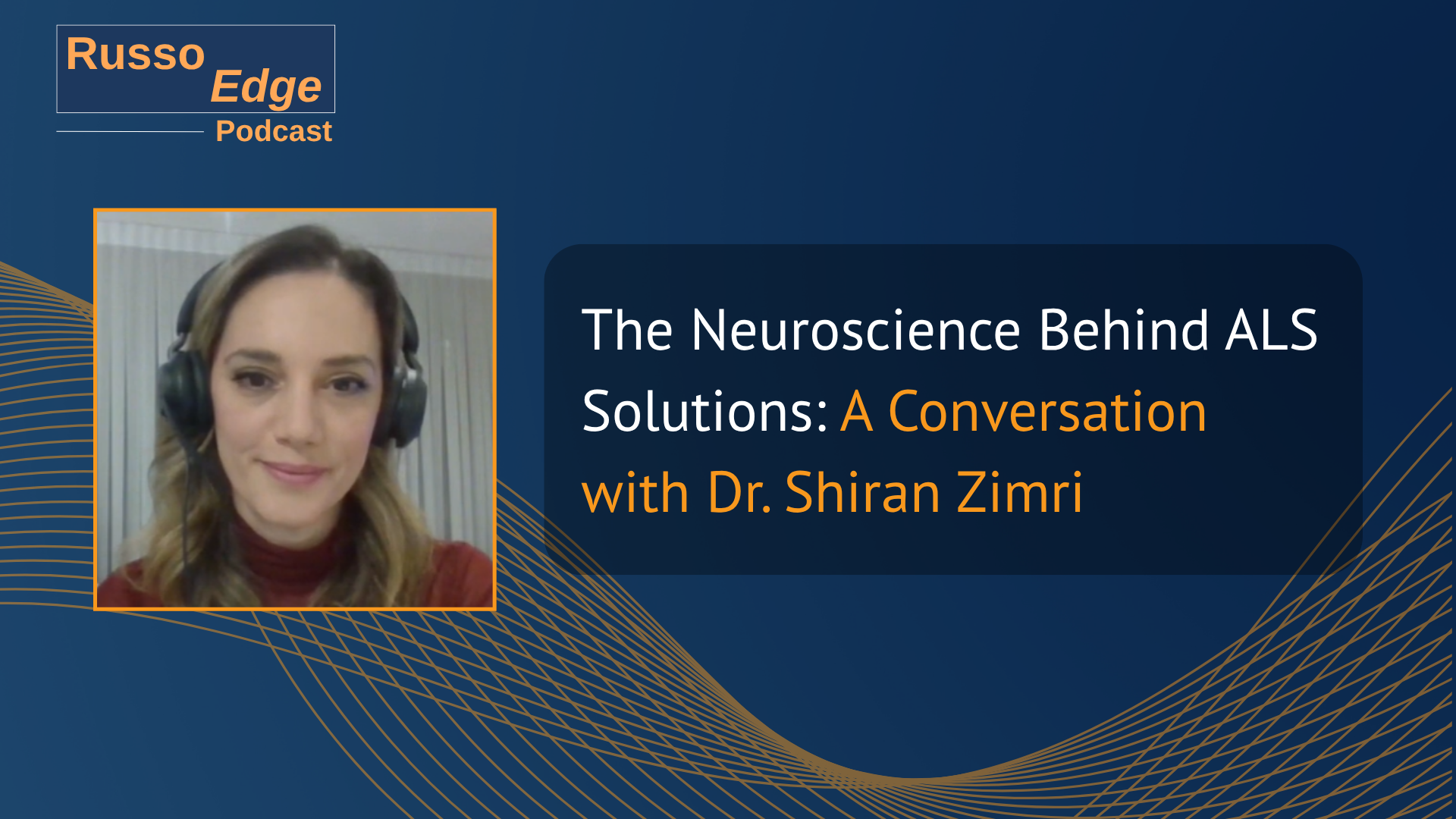
Dr. Shiran Zimri, Vice President of R&D at Neurosense Therapeutics, joins the Russo Edge Podcast and shares her journey as a scientist tackling neurodegenerative diseases like ALS.
In this episode, Dr. Zimri explains how NeuroSense’s innovative combination therapy, Prime C, could reshape ALS treatment by addressing multiple pathways involved in the disease. She provides a behind-the-scenes look at the company’s recent clinical trial successes, and the deeply personal story that inspired the founding of NeuroSense.
From PhD Research to Clinical-Stage Innovation
Solomon Wilcots: Today’s conversation is with Dr. Shiran Zimri, Vice President of R&D at Neuroscience Therapeutics, a company pioneering new treatment options for people living with ALS. Shiran and her team are focused on creating combined therapeutic strategies that target multiple pertinent mechanisms driving these complex diseases. Sharon is an expert in preclinical drug development, with over a decade of experience researching neurodegenerative diseases through multidisciplinary approaches. Dr. Zimri’s work has been featured in leading scientific journals all over the world.
Welcome, Shiran. How are you doing today?
Shiran Zimri: Great. How are you?
Solomon Wilcots: Doing great. Shiran, why don’t you tell us a little bit more about yourself and what led you to study neurodegenerative diseases and how you reached your current position at Neuroscience Therapeutics?
Shiran Zimri: Sure, with pleasure. I joined NeuroSense Therapeutics early in 2020 after I completed my PhD in neurobiology, focusing on neurodegenerative diseases. I have been working on Alzheimer’s disease for a long period of time. Being in this field, I was always fascinated by the brain and how we can understand what happens when it goes bad and how we can understand it better in order to fix it. That curiosity has been with me as long as I can remember.
When I met Alon Ben-Noon, the CEO of NeuroSense, and heard the company’s story and what brought him to found Neuroscience Therapeutics, it really resonated with what I wanted to do in my life—creating impact and focusing on tackling ALS. The urgency and purpose aligned with my mission. This is what drove me to start working at NeuroSense Therapeutics. It was love at first sight—it immediately felt like home.
I joined NeuroSense when it was a very small company; I was the second employee. We were small but had big dreams. Transitioning from a small company to a Nasdaq-listed one with successful phase two studies and now facing phase three has been a great journey filled with collaboration, resilience, and adventure. I feel so fortunate to have been part of this journey, working with people who share the same mission: bringing real hope to patients living with ALS and their families. That’s what drives and motivates us every day.
Understanding ALS as a Multifactorial Disease and Its Impact on Patients
Solomon Wilcots: I think it’s a very noble cause that you have, that’s for sure. And you have the talent to be able to meet that mission. What more can you tell us to help us understand a disease like ALS and the profound impact it has on patients and their families?
Shiran Zimri: ALS, unfortunately, is a devastating neurodegenerative disease that progressively affects individuals’ ability to move, speak, eat, and eventually breathe. The emotional and physical burden impacts not only people living with ALS but also their caregivers and families. This is exactly what drives us—to advance therapies not just to slow disease progression but to create hope and improve quality of life for patients and families.
Solomon Wilcots: Now, going back to NeuroSense Therapeutics and your unique approach, how do combination therapies differ from traditional single-drug approaches, and why is understanding multiple pathways so important in addressing complex diseases like ALS?
Shiran Zimri: ALS, like all neurodegenerative diseases, is multifactorial, involving multiple pathways and mechanisms. Thinking that there could be a “silver bullet” for such a complex disease is likely wrong. We need to shift the paradigm toward combination therapies.
Combination therapies like ours target various key mechanisms that underlie the disease’s pathology, offering a more holistic and effective approach than single-drug treatments. By addressing multiple pathways, we aim to improve clinical outcomes and patients’ quality of life.
Inside the Science Behind PrimeC
Solomon Wilcots: Looking specifically at PrimeC, can you tell us about its components and how it acts as a combination therapy for ALS?
Shiran Zimri: Sure. PrimeC is designed to target multiple pathways involved in ALS. Its components work synergistically to have a greater impact—where one plus one equals more than three. Each component targets key pathologies such as neuroinflammation, iron accumulation, and oxidative stress, which all lead to neuronal death.
It also targets a novel pathway we’ve been studying regulation of microRNA. Altogether, we’re addressing multiple pathways to create meaningful impact. PrimeC shows potential in modulating these targets, and with this multiphase strategy, we hope it becomes a unique and promising therapy candidate in the fight against ALS.
Linking Repetitive Injury to ALS Risk
Solomon Wilcots: As you know, I come from the football world, and we’ve seen many former NFL players like Steve Gleason suffer from ALS. Recent studies from Harvard Medical School show NFL players have four times higher risk of developing ALS. Can you tell us more about this correlation?
Shiran Zimri: The increased risk among NFL players is linked to what we call “second hits.” These can be traumatic brain injuries or extensive exercise. In the scientific world, “second hits” refer to additional stressors—physical or environmental—that accelerate disease onset or progression in individuals who may already have a genetic predisposition.
This concept is familiar from Alzheimer’s research, where similar secondary factors like stress or injury can hasten disease progression. These “second hits” are thought to push the disease forward faster.
Key Phase 2b Results From the PrimeC Trial
Solomon Wilcots: Can you walk us through some of the recent clinical trial results from PrimeC and what has been most promising in terms of patient outcomes or symptom management?
Shiran Zimri: Completing the 18-month phase 2b Paradigm study was a huge milestone for NeuroSense and the ALS community. PrimeC showed great results in slowing disease progression and demonstrated strong safety and tolerability.
The study involved participants across multiple countries, comparing those who received PrimeC to those on placebo for six months, followed by a one-year open-label extension. Impressively, 96% of participants chose to continue treatment.
The findings are incredibly encouraging. We observed a 33% slower decline in function and a 58% improvement in survival rate. That translated to an eight-point difference in the clinical outcome scale—meaningful changes that affect patients’ independence, such as walking or eating on their own.
PrimeC also showed significant effects on iron metabolism and regulation of microRNA—key pathways in ALS. We identified new biomarkers as well, making these results scientifically and clinically exciting. With FDA support, we’re now preparing for a phase three study to bring this therapy closer to patients.
The Patient Story That Sparked NeuroSense Therapeutics
Solomon Wilcots: That’s just phenomenal. And we know the story behind NeuroSense’s formation is special, including the bond between your CEO, Alon Ben-Noon, and a person living with ALS. What more can you tell us about that?
Shiran Zimri: For me, it’s the ultimate inspirational story. NeuroSense was essentially born from a patient. It started from a life-changing meeting between Alon—then working in the pharma industry—and Shay Rishoni, a very active ALS patient who was completely paralyzed and communicated with his eyes.
That encounter moved Alon deeply. He thought, “How can this person do so much to advance ALS therapy while I, in this industry, do so little?” Within a week, he gathered people and ideas, and NeuroSense was born.
This story still inspires us every day. Even the name “PrimeC” is a tribute to Shay— “Prime” translates to “Rishoni” in Hebrew, his last name. It’s a constant reminder of why we do what we do and motivates us to work faster and better for patients.
A Transformative Year Ahead for NeuroSense
Solomon Wilcots: As we look forward to 2025, what’s on the horizon for NeuroSense Therapeutics?
Shiran Zimri: This year is going to be transformative for us. We’re preparing for a phase three trial with PrimeC, aiming to validate its efficacy and make it available to patients as quickly as possible. We’re also pursuing conditional approval in Canada to enable earlier access.
Additionally, we’ve signed a transformative agreement with a global pharmaceutical company, which reflects growing recognition of our innovative approach. Beyond ALS, we’re advancing our Alzheimer’s disease program and exploring how combination therapies can address other neurodegenerative diseases.
It’s an exciting time ahead for NeuroSense and the communities we serve.
Solomon Wilcots: Well, Shiran, we want to thank you for joining us today. You’ve been a phenomenal guest. Dr. Shiran Zimri, Vice President of R&D at Neuroscience Therapeutics, thank you for your wonderful insights on developing new therapies for ALS patients. I’m Solomon Wilcots, and this is The Russo Edge. Thank you for listening, everyone.
The Russo Edge Podcast is hosted by Solomon Wilcots and features candid conversations at the intersection of biotech, healthcare, and innovation, spotlighting leaders, scientists, and investors moving medicine forward. The following transcript has been edited for clarity.