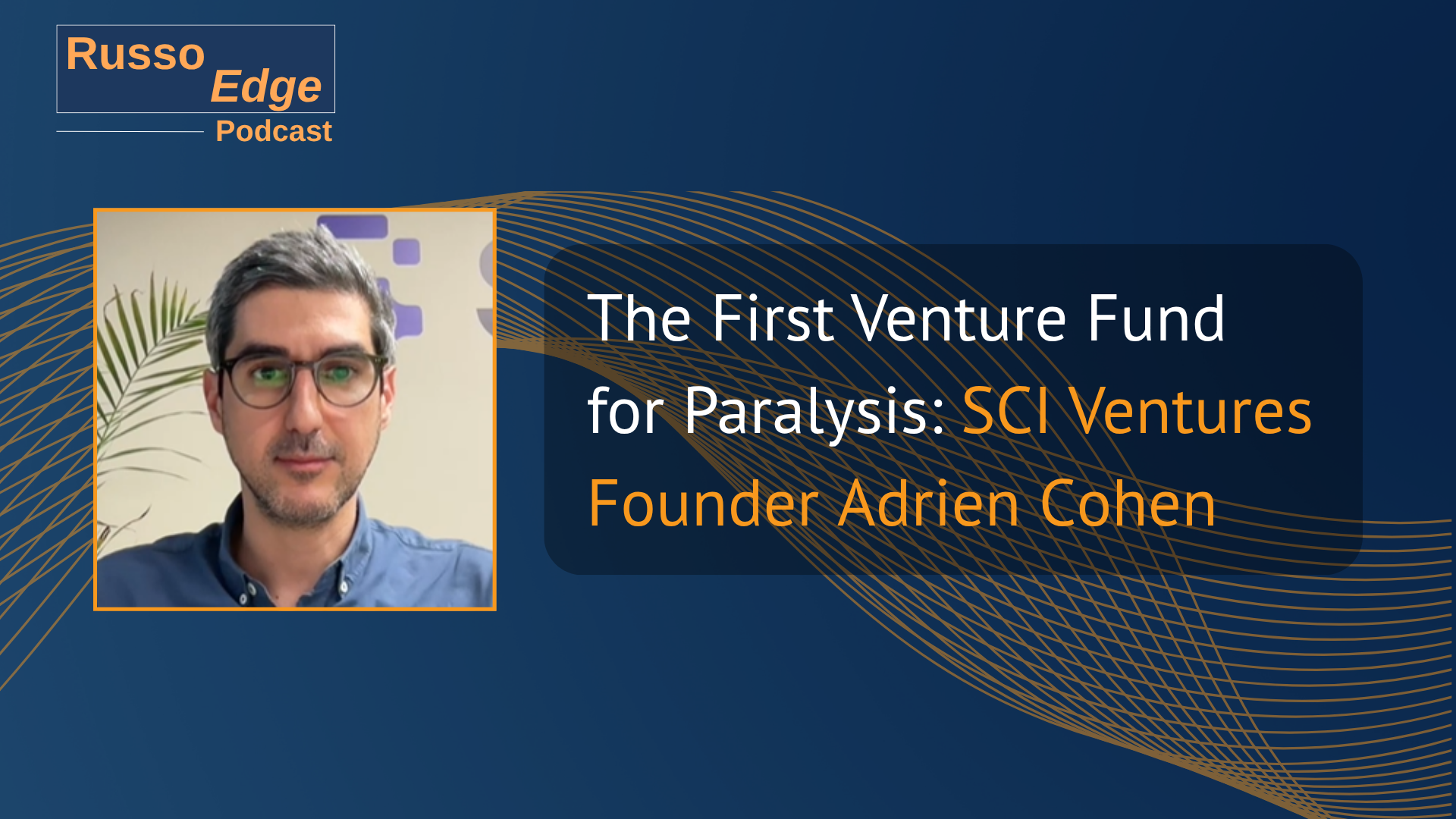
In this episode of the Russo Edge, Adrien Cohen, founder of SCI Ventures, joins host Solomon Wilcots for a conversation about building a global venture philanthropy fund designed to accelerate therapies for spinal cord injury. Adrian shares how his personal journey brought him into the SCI community, and why the most promising science too often stalls in the gap between academic discovery and clinical adoption.
Solomon Wilcots: Welcome everyone to the Russo Edge Podcast. I’m your host Solomon Wilcots. And today we’re joined by Adrien Cohen, founder of SCI Ventures, a first of its kind global venture philanthropy fund focused on accelerating treatments for spinal cord injury and paralysis. Adrian is no stranger to startups that reach unicorn valuations. He co-founded Lazada. One of Southeast Asia’s leading e-commerce platforms and helped build Tractable, a United Kingdom AI company that reached unicorn status. After a spinal cord injury touched his life personally, well, Adrian turned his focus to a condition affecting millions worldwide but long overlooked by traditional investment.
Adrien, welcome to the show. How are you doing today?
Adrien Cohen: I’m doing fine, thanks for having me.
When Paralysis Redefined an Entrepreneur’s Purpose
Solomon Wilcots: Well, it is great to have you. Let’s get started by just asking you some simple questions. Can you walk us through the turning point that brought you to SCI into this wonderful business that you’re in? And then in what way did it set in motion what you’re doing now professionally?
Adrien Cohen: Yeah, well, I’m a tech entrepreneur. I created SCI Ventures a few years ago because I wanted to see change in paralysis and neuro regeneration. I don’t know if it’s wonderful, it is definitely a personal connection that led me to the word of spinal cord injury. My brother had a bad accident, broke his back, ended up paralyzed from the waist down, which was a big shock. At the time, I did what many other families did in similar situations. I started calling a number of scientists around the world, in the U.S., Europe, Asia, everywhere. I just wanted to know the lay of the land, what was out there, what kind of therapies would be available? And I ended up very frustrated, very disillusioned after speaking with thousands of scientists.
On the one hand, the science was very promising and very exciting, but it was also very clear that there was no vehicle to take this innovation and bring it from the lab to the clinic and to the real world. That means no trajectory for options for my brother and 20 million people worldwide living with paralysis. That’s why I created SCI Ventures, the first specialist venture fund dedicated to paralysis.
Fixing the Funding Gap With a Mission-Driven Venture Model
Solomon Wilcots: Well, you described a gap between academic breakthroughs and world therapies. Now, what’s causing that disconnection in SCI and why aren’t innovations reaching patients?
Adrien Cohen: Yeah, this gap exists in many neglected conditions. It is especially severe in spinal cord injury. There are many issues, but I would say the core issue is that traditional venture capital is not playing its role. Traditional VCs are generalist investors, so they don’t understand the specificity of the indication. There are also no clear historical commercial successes to point to, success stories. So overall, the risk is perceived as being too high by traditional investors. And so that’s why SCI Ventures exists, is to really fix this market failure. To create more success stories, to really prime the pump so more investors will join in, and ultimately more therapies will be developed.
Solomon Wilcots: Tell us more about SCI Ventures. What is a venture philanthropy fund and how did you design this model to break through many of those barriers?
Adrien Cohen: Yeah, indeed. Venture philanthropy is not a new model, but somewhat unheard of, especially here in Europe where I’m based, a bit more developed in the U.S. It’s essentially trying to marry the VC discipline with a mission. And so, we operate like a traditional venture fund, but there’s two main differences. One, we’re an expert investor. So we have the expertise, the network to really understand the indication. And as a result, to lower the risk for others to invest with us in the space.
Number two, we’re structurally evergreen. What that means is that 100% of the profits we make are not distributed like a traditional VC. They’re reinvested, recycled to the mission, so that you have this vehicle that is an expert, is credible, and is continuously financing the mission until we get to the right level of therapies.
To achieve that, we co-created the fund with five leading institutions. We initiated the model with the Christopher Reeve Foundation, which I’m sure you’re familiar with. They were a pioneer in the space, and they helped us initiate the model. Then we garnered the support of four more co-founders, Wings for Life, Shepherd Center in Atlanta, Promobilia in Sweden, and Spinal Research in the UK. We have this expertise and network, U.S., U.K., Europe, and that is what gives us, an actual superpower.
Solomon Wilcots: Well, as you mentioned, you didn’t build SCI Ventures alone, along with the Reeve Foundation, Wings for Life, and many others. How did you get so many leaders in one place at the same time, all going in the same direction?
Adrien Cohen: If you take a step back, the Reeve Foundation pioneered this model early, and that predates me. In 2016, they invested in a company that became Onward Medical, which is a company that’s developing a technology to stimulate the spinal cord. They got the first FDA approved therapy for chronic paralysis ever in 2024, which is a huge milestone. So they invested five million in 2016 and in seven years, they got to FDA approval, and they raised more than $200 million and are now listed on NeuroNext. So that was a massive success and the whole point of SCI Ventures was to say, well, how do we replicate this success? How do we industrialize this success, how do you make that more systematic? We need a vehicle to do that, not one time, but 20 times.
Together with the Reeve Foundation, we agreed we had to create a global vehicle that we didn’t want to see a fragmented space with multiple small firms. We reached out to other foundations around the world. And all of the foundations, Wings for Life, Shepard, ProMobelia, Aspander Research, they all agreed with our assessment that there was this big gap, that all of academic research funding was very important, but that there is a gap in the market and that we needed to activate this research and bring it to the clinic through venture capital. We all decided to unite, all the foundations put capital in the vehicle and bring their expertise and network. And I’m very grateful because our vehicle wouldn’t exist without those foundations.
From Lab to Home Use: Emerging SCI Technologies
Solomon Wilcots: Now, the fund has already backed a number of companies. So without going too deep into the weeds, can you share a few innovations that really do give you the most hope right now as we move forward?
Adrien Cohen: Yeah, we have backed already eight companies, and that’s across innovation that can help to replace or restore lost functions, and eventually also repair the nervous system. I guess I can talk about three examples that I hope will be a good illustration of the type of technology we back. The first one we touched upon already, Onward Medical. It’s a spinal cord stimulation to restore movement and function. It got the first FDA approval ever in SCI last year, and their first product, the ARC-EX, this stimulator device, is now approved for home use. So as we talk, as we are speaking right now, it’s being deployed in rehabilitation centers, and it is accessible for people to use in their home. So that’s the first one.
A second one I’d love to talk about is NervGen, which is a company in the US that’s developing a regenerative drug, and they’ve had very successful clinical data. Twenty people went through a clinical trial last year in Chicago and got very durable functional improvement. And so, I have high hopes that this drug could become the first regenerative drug that’s FDA approved in the wake of Onward.
And the third one I will mention is probably… I don’t want to make any company jealous, but I guess I will pick here, which is Healx AI here in the UK where I’m based in Cambridge. They’re an AI drug discovery company. They use AI to analyze massive data sets and to find new mechanisms to regenerate the spinal cord and to fight drugs that they could repurpose. The use of AI here is to really accelerate the time to go from discovery to the clinic. It’s essentially developing the next generation of therapies. We have already, I would say, innovation that is making a difference today, but we’re also preparing for the future.
Scaling Paralysis Solutions Into Wider Neuro Medicine
Solomon Wilcots: Wow, sounds very promising. And we’re looking forward to hearing more on that. And some of these technologies like implant cell therapy, gene therapy, or even neuromodulation, they could all have uses beyond spinal cord injury. So how do you think what you’re building right now might ripple out to other neurological conditions?
Adrien Cohen: SCI, first as a spinal cord injury in itself, is a massive unmet need. And too often I see people thinking that this is a niche. So, I just want to share the numbers here, it’s 20 million people affected worldwide and it’s an average of $5 million of lifetime costs per individual. So we’re talking about a $100 billion societal burden. That’s a very, very large problem. But as you said, there’s also a clear overlap with other neuroindications. There are a lot of commonalities between the brain and the spine. It’s the same nervous system. And so, when you think about neurodegenerative conditions, ALS, Multiple Sclerosis, you think of other neuro injuries, stroke, brain injuries. There is clear expansion of the innovation we back to also benefit people suffering from those indications.
In fact, if you look at our portfolio, I can pick two examples. EG427 is a gene therapy company going after bladder dysfunction. And it is helping and relevant for people living with spinal cord injury and living with Multiple Sclerosis. NervGen, which we talked about, is about repairing the nervous system and they have data for stroke and brain injury. So if you zoom out solving paralysis also will unlock progress across neurology which is a massive medical progress.
Defining Long-Term Success in Paralysis Recovery
Solomon Wilcots: That’s phenomenal, it really is. And if you continue to look ahead, and let’s just say we fast forward, maybe 10 years from now, Adrien, what does success look like for SCI Ventures? And what’s the world, you know, hoping to build? What are you hoping to build in this world?
Adrien Cohen: Success is pretty obvious, right? We need to see multiple therapeutic options approved. We need see that functional recovery is a standard after an injury, not an exception. We need a healthy ecosystem, that means hundreds of millions being invested, companies being formed, more people working to fight paralysis. I think we’re at a historic point. I think recovery from paralysis is now possible. As you said, it’s driven by AI discovery, cell and gene therapy, neural interfaces. So if I look ahead, I think in five years, we should have meaningful functional recovery options for bladder, for bowel, for blood pressure, for pain. And then 10 years from now, I hope to see a biological repair of the spinal cord possible, a cure.
Solomon Wilcots: Well, Adrien, thank you for joining us. From startups to spinal cord recovery, your mission really is bold. It’s very focused and filled with tremendous promise. To our listeners, thank for being here and joining us as well. I’m Solomon Wilcots and this is the Russo Edge Podcast.
The Russo Edge Podcast is hosted by Solomon Wilcots and features candid conversations at the intersection of biotech, healthcare, and innovation, spotlighting leaders, scientists, and investors moving medicine forward. The following transcript has been edited for clarity.