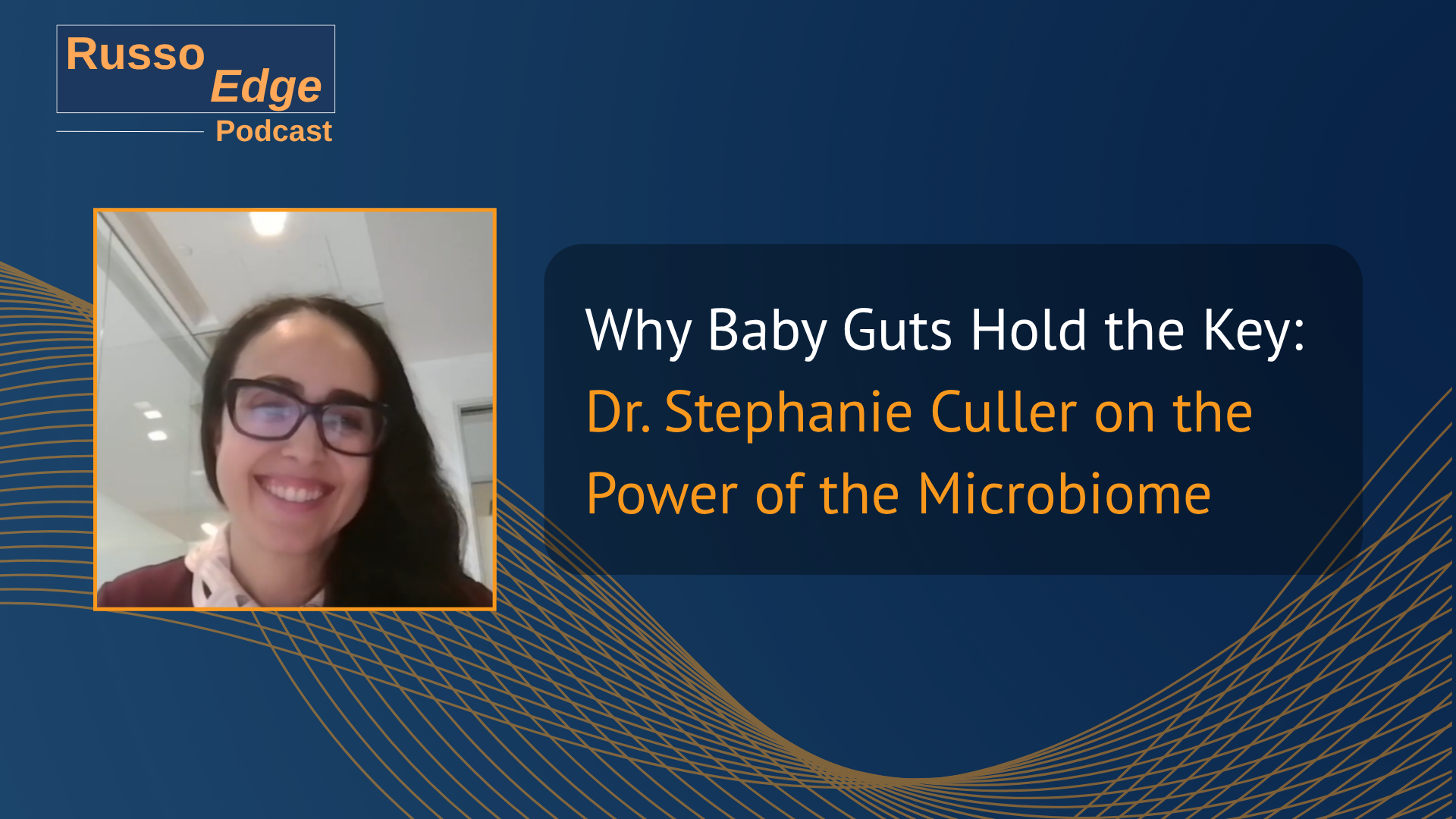
What if the earliest chapters of lifelong health are written in the gut — before a child even reaches preschool? Modern babies are often born without key microbes that train the immune system, leaving them more vulnerable to chronic conditions like allergies, asthma, and eczema.
This episode of The Russo Edge, Dr. Stephanie Culler, Co-founder and CEO of Persephone Biosciences, explains what makes the infant gut unique, why nine out of ten U.S. babies are born with microbiome deficiencies, and how her team is developing a synbiotic designed to replenish what’s lost.
From cancer research to dirty diapers, this is an entrepreneur’s story of resilience, humor, and groundbreaking science — and why the smallest organisms in our gut may hold the biggest key to lifelong wellness.
Solomon Wilcots: What happens when a scientist loses her loved ones early in her life to cancer and turns to the tiniest creatures in our gut for answers? Well, today’s guest found something missing in nine out of 10 U.S. Babies and she believes the future of preventative medicine might just start with the microbiome. Welcome to the Russo Edge Podcast, everyone. I am Solomon Wilcots. Today, we are joined by Dr. Stephanie Culler, co-founder and CEO of Persephone Biosciences, a company on a mission to harness the human gut microbiome to help prevent and treat diseases.
Stephanie’s passion for solving health problems began when she lost both of her grandparents to cancer during her teenage years. That early loss led her to pursue a PhD at Cal Tech in gene therapy and later a career in biotech. We’ll hear about Stephanie’s journey from academia to entrepreneurship and how being a mom and a scientist drives her work still today and how Persephone’s innovative microbiome platform could transform pediatric health, and most of all, being the queen of poop. Stephanie, how you doing today?
Stephanie Culler: Doing well, how are you doing?
Building Persephone Biosciences From Science and Purpose
Solomon Wilcots: We’re doing awesome. Let’s go ahead and get started by talking about your career in cancer research and take us through your journey. What drove you to academia and launching your company, Persephone Bioscience, back in 2017?
Stephanie Culler: I lost both my grandmothers back-to-back to cancer when I was a young teenager and I really wanted to have an impact in cancer. At the time, as a young teenager, I don’t know what that is. But that drove me to become a scientist, and the work that I did during my PhD at Caltech, to come up with new gene therapies using synthetic biology. Through that work, I really wanted to become an entrepreneur.
I wanted to translate this into therapeutics and quickly realized that I didn’t have any experience in industry. I really didn’t know anything about biotech. That’s what actually drove me after graduate school was to come down to San Diego where our company is based and work in industrial biotech to learn what it is like to have a company and develop groundbreaking technologies. During that time period, myself and my co-founder who I met at that company, we became real experts in microbes like the bacteria we have in our gut microbiome and through developing commercial technologies around that with that expertise.
After that, we wanted to move on and impact human health. I wanted to go back to this mission in cancer. During that time, I became fascinated by the human gut microbiome and how it seems to impact virtually every disease that we know of. Thinking about our expertise in microbes and our personal passion in human health, we founded Persephone Biosciences in the summer of 2017 to build a technology and platform to truly unlock the potential of the gut microbiome for the treatment and prevention of disease.
Identifying a Hidden Microbiome Deficiency in Babies
Solomon Wilcots: I think it’s an incredible, fascinating study. When was that moment that crystallized for you when you knew that you needed to study the gut health of these little babies? And why did that connect to the rise in childhood chronic condition?
Stephanie Culler: That is a great question. For the first five years of this company, we actually only focused on cancer research where the microbiome has been shown to have a tremendous impact on how cancer patients respond to the latest immunotherapy drugs. It impacts their immune response. Along that journey, I ended up connecting with scientists actually in the pediatric space.
A discussion with the leading pediatric clinician, Dr. Dick Ansel, led me to learning more about the infant gut. And what surprised me most was that I didn’t know there was a problem with the microbiome of infants. It turns out today; this is a global issue. Modern babies, because of industrial practices and medical practices like antibiotics, C-sections, poor diet, even geography, today are born with a microbiome deficiency. They are missing the right bacteria that normally train the immune system. Without these bacteria, these children are much more at risk for developing chronic conditions like food allergies, eczema, asthma, diabetes, and many more. It’s that really early microbiome that’s important for their health.
How Early Microbiome Development Trains the Immune System
Solomon Wilcots: Further explain how a healthy microbiome in infants can really impact a child’s immune development as they continue to grow.
Stephanie Culler: Absolutely. For the first several years of life, from birth through preschool, the microbiome is developing. What we’ve found in newborns in our My Baby Biome study, many of them only have about a dozen kinds of microbes. You and I have several hundreds. During those first three years, the microbe is developing, it’s going from like 10 or so microbes to hundreds of microbes and it looks much more like an adult microbiome by the time they go to kindergarten. Those early years are shaping, or we say imprinting the immune system for life.
Solomon Wilcots: Wow, that’s just simply incredible. I know you often sometimes joke about being the queen of poop. How has leaning into that honestly helped you build a trust between many of the participants and many of the partners that you’re working with?
Stephanie Culler: Yeah. Well, I’m very thankful for the poop emoji to really kind of take away the stigma around poop and making it fun. We struggled in the early years of the company with actually collecting stool samples from cancer patients. Nobody wanted to give us poop samples. But the minute we made it fun and we coined our clinical research “poop for the cure” was the minute that we really could start to connect with people, that people understood at that point, we connected this to all the research, all the things that we can find out to help people. That truly has been a game changer in how we engage people and actually build trust.
Turning Microbiome Science Into an Infant Health Solution
Solomon Wilcots: Well, I know you’re developing a synbiotic for babies. In plain English, help us to understand what that is and how could it help replenish missing bacteria of specific types and support immune development.
Stephanie Culler: Great question. A synbiotic is a really fancy word for prebiotics and probiotics. Probiotics are the microbes themselves; prebiotics are their food. Our synbiotics is really special because these are the right probiotic strains that the babies need for their immune system to develop and the right prebiotic. These are prebiotics only found in breast milk, and they feed these particular gut microbes. Our product that we’re developing, is strictly made for babies, this is an example, it’s a powder and it’s something that can be easily added to food, milk, etc.
Solomon Wilcots: Well, you decided to go the retail route instead of a prescription path for your first product. Why is that?
Stephanie Culler: Great question. Well, this is a product for the masses. Our research from the My Baby Biome Study showed that nine out of ten babies in the United States have this microbiome deficiency — nearly every baby in the U.S. We wanted to go a route that every child has access and that’s why we’re bringing it direct to consumer, launching initially on our website and then getting into broader retail nationwide over the next year. We also thought, you know, this was a dietary supplement, so that’s over the counter. There may be versions of this that become prescription based as we start to look at additional indications like eczema and food allergies.
Building a Consumer Biotech Company Without a Playbook
Solomon Wilcots: Yeah, and Stephanie, you know, you’re a scientist turned CEO. What are some of the challenges you faced in translating lab research into a consumer product and a startup company?
Stephanie Culler: I would say that’s my biggest challenge. I was not trained for this. It’s learning on the job type of thing. My greatest challenge here, and I think it is with most scientists, is that in our training, we’re taught to talk about the science in a very in-depth manner, and having to basically boil that down, condense it. What does the customer actually need to know? What do investors need to know? That has been the biggest challenge, but over the years I have really learned what is the essence of what we’re trying to develop.
Solomon Wilcots: Tailoring the message is so very important. Now as you look ahead, what kind of impact do you hope Persephone will have on the world? What changes and in what way would you like to make an impact?
Stephanie Culler: I would love to have — and I believe this, I truly believe this — that this product will help reduce the incidence of food allergies, eczema, and other chronic conditions. I really think we can start to prevent these chronic illnesses worldwide.
Solomon Wilcots: Do you have any words of wisdom out there for other biopharma entrepreneurs and leaders that are out there? What advice would you give them or give someone who has that big vision in biotech?
Stephanie Culler: I think it takes a lot of resilience and grit. It gets hard, but really aligning yourself with a mission, a North Star that you can go back to because there are times when there are highs, but there are so many lows that if you can ground yourself in a mission that you truly believe, it will help you get out of those tough times.
Solomon Wilcots: Yeah, it’s going to be really great. The work that you’re doing — we want to thank you for taking the time to join us. Dr. Stephanie Culler of Persephone Biosciences. Keep up the great work and we look forward to staying in touch with you and catching up with you again soon. Thank you for joining us everyone on the Russo Edge Podcast.
The Russo Edge Podcast is hosted by Solomon Wilcots and features candid conversations at the intersection of biotech, healthcare, and innovation, spotlighting leaders, scientists, and investors moving medicine forward. The following transcript has been edited for clarity.